Guided meditation for anxiety means following spoken or written prompts to notice your experience and return attention to a chosen point, such as a sound or the feeling of your feet on the floor. The script below offers a 10-minute practice and a shorter 5-minute version, without requiring an empty mind or promising immediate relief. Goyal and colleagues’ 2014 JAMA Internal Medicine review supports some structured mindfulness programmes for anxiety, but this particular script has not been clinically tested.
You can try it when you have a little uninterrupted time. Choose whether to continue according to how the practice feels, rather than treating the timer as something you must finish.
Before you begin a guided meditation for anxiety
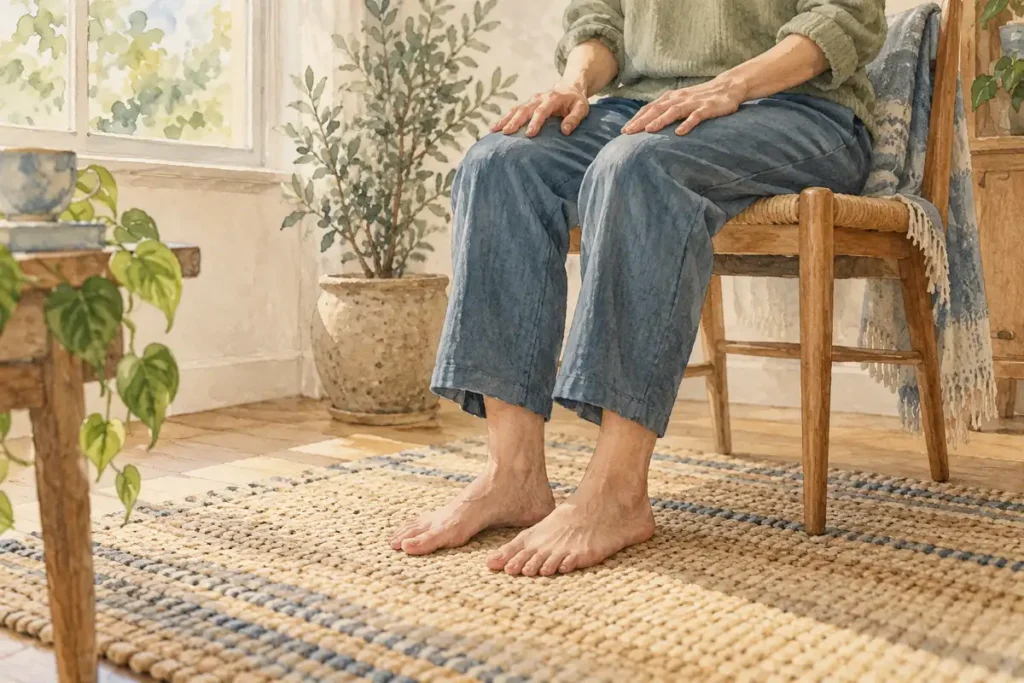
Sit somewhere you can pause safely. A chair is fine: let it support your back, rest your hands wherever comfortable, and put your feet on the floor if that suits you. Keep your eyes open or lower your gaze. There is no requirement to sit cross-legged, make a special hand gesture, or close your eyes.
Choose an attention point before starting. It could be the contact between your feet and the floor, a steady sound in the room, or ordinary breathing. In this guide, an attention point is simply something to return to when you notice that your thoughts have moved elsewhere.
You do not have to deepen, slow, count or hold your breath. If noticing breathing feels unpleasant, choose a sound or the chair’s support instead. For more help with setup, read LifeNByte’s beginner’s guide to meditation.
Keep the practice separate from driving, cooking over a flame, or anything else that needs your full attention. If you are dealing with an urgent problem, take the necessary action first. Meditation does not require you to ignore what is happening around you.
A 10 minute meditation for anxiety
This is an original LifeNByte script. Read each section slowly, then leave quiet time until the next two-minute interval. You can record yourself reading it, ask someone to read it with the pauses, or read a section and practise without looking at the page.
The intervals include both words and silence. To practise for ten minutes, spend two minutes on each section, including reading and quiet time. If you finish the words before an interval ends, stay with your attention point until the next interval begins. Reading pace varies, so you can use a timer or follow the sections without a fixed duration. You can stop at any point.
Minutes 0 to 2: Find a comfortable starting point
Let the chair or cushion support you. Notice where your body meets it. Adjust your position if you need to; discomfort is not a requirement of this practice.
Look around the room. Notice an object, its colour, and where it sits. You can keep your eyes open throughout.
Now choose one place for your attention to rest. Perhaps your feet touching the floor. Perhaps a sound nearby. Perhaps the movement of an ordinary breath.
There is nothing you need to make happen. Spend the remaining time noticing that point. If another thought appears, return when you notice it.
Minutes 2 to 4: Notice without changing your breathing
If you have chosen the breath, notice how it feels as it is. There is no count to follow and no breath to hold.
If you have chosen your feet, notice the contact with the floor. If you have chosen a sound, listen without needing to identify everything you hear.
A thought may arrive about this morning, tomorrow, or whether you are doing the exercise correctly. You can recognise that you are thinking without answering the thought right now.
Return to the point you chose. Allow quiet time here. When attention moves, begin again without adding a judgement about yourself.
Minutes 4 to 6: Make room for a thought without following it
Notice whether a worry is asking for your attention. You do not have to push it away or work through it during this interval.
You might quietly name it as a thought or a worry. Use that label only if it is helpful. You can skip the label and return to the room.
Feel the chair beneath you, hear the sound you chose, or notice your feet. You can recognise a thought and still choose where to place attention next.
If the thought needs a practical response later, you can make that decision after the practice. For now, stay with your chosen point for the remaining time.
Minutes 6 to 8: Choose what feels manageable
Check whether you want to continue in the same way. You may keep your attention point, choose another one, or move your body a little.
If you prefer to look outward, notice the edge of a table, the light on a wall, or a sound in the room.
You may feel more settled, much the same, or less comfortable. You do not have to turn any of those experiences into a verdict about your ability to meditate.
Continue only if you want to. Spend this interval with a point that feels manageable, leaving pauses between the words.
Minutes 8 to 10: Return to the rest of your day
Bring attention back to the room. Notice what you can see and hear. Feel where you are sitting and move your hands or feet if you wish.
Ask what you need next. It might be a drink of water, a conversation, or getting back to a task. You do not need a special feeling before you can finish.
If a concern needs action, choose one specific next step. Leave questions that do not need an answer now for another time.
Remain here until the interval ends, or finish sooner. When you are ready, end the practice and continue with your day.
A 5 minute guided meditation for stress and anxiety
Use this shorter version when you prefer fewer instructions. Read each step, then practise quietly for the rest of that minute before moving on. These timings are editorial choices for this exercise, not a clinically established minimum dose.
- First minute: Sit comfortably and look around. Choose the floor beneath your feet, a sound, or ordinary breathing as your attention point.
- Second minute: Notice that point. Leave your breathing alone; there is no requirement to take deep breaths.
- Third minute: When you notice a thought, acknowledge it briefly and return. You do not have to decide whether the thought is reasonable during the exercise.
- Fourth minute: Continue, change your attention point, or open your eyes if they were closed. Make the practice easier to stay with rather than more demanding.
- Fifth minute: Notice the room again. Choose what to do next and finish, even if your mood has not changed.
If you prefer a practice that moves attention through different parts of the body, try LifeNByte’s body scan meditation scripts. You can also leave body-focused practice aside and keep your attention on the surroundings.
What research says about mindfulness meditation for anxiety
Madhav Goyal and colleagues’ 2014 JAMA Internal Medicine systematic review and meta-analysis included 47 trials involving 3,515 adults in clinical populations. It found moderate evidence of small anxiety improvements from mindfulness programmes versus comparison programmes that matched time and attention without offering an established treatment. Evidence for stress or distress was weaker, and superiority to other active treatments was not established.
Goyal and colleagues’ 2014 JAMA Internal Medicine review excluded audio- or video-only programmes without a meditation teacher physically present. Its findings therefore do not directly establish the effects of an individual recording or this script.
Elizabeth Hoge and colleagues’ trial, published online in 2022 and in the 2023 issue of JAMA Psychiatry, compared mindfulness-based stress reduction with escitalopram in 276 adults with anxiety disorders. The primary analysis included 208 participants who completed the trial. At the eight-week endpoint, the programme met the study’s predefined criterion for noninferiority: its results were not worse than the medication by more than the specified margin.
Hoge and colleagues’ 2023 JAMA Psychiatry trial used weekly 2.5-hour classes, a day-long retreat and 45 minutes of daily home practice. This was a taught programme, not a brief self-guided session. It does not establish that this script can replace medication. Discuss treatment changes with your clinician.
When a calming meditation does not feel calming
You can stop if the practice feels increasingly upsetting. Miguel Farias and colleagues’ 2020 Acta Psychiatrica Scandinavica systematic review of meditation adverse events documented adverse experiences, including anxiety, across varied meditation practices and study designs. Those findings do not provide a specific risk estimate for this script, but they do challenge the idea that meditation is always harmless.
Try opening your eyes, changing position and looking around. If breath awareness is uncomfortable, stop following the breath. You can choose an external sound, stand up, or end the session altogether.
These are options for adapting or ending the exercise, not instructions to treat a panic attack. If panic is recurring, or meditation brings up distressing memories or a feeling of disconnection, speak with a qualified clinician about whether self-guided practice is suitable for you.
If sitting practice is a poor fit, LifeNByte’s quick stress relief techniques offers other activities to consider. You do not have to keep meditating to prove that you gave it a fair chance.

Meditation for anxiety and sleep
For evening practice, you can use the same script with the lights lowered and a comfortable position. Let bedtime be the reason for finishing; there is no need to restart because you lost track of a section.
The purpose can simply be to spend a little time with the instructions before bed. Avoid using falling asleep within a certain number of minutes as your test of success. This script has not been tested as an insomnia treatment, and it cannot promise sleep.
If anxiety is interfering with sleep or daily functioning, consider professional support. The National Institute of Mental Health’s 2025 guidance on generalized anxiety disorder describes treatment with psychotherapy, medication, or both, with choices based on the person’s needs and a clinician’s assessment. It describes stress management practices as possible support alongside care, rather than a replacement for treatment.
How to choose a guided meditation you will actually use
Choose instructions you can follow and a voice you can comfortably listen to. Listen to a short sample before starting, checking whether the pace and gaps between prompts suit you. Look for an eyes-open option or sound-based focus if you prefer those to body sensations.
Leave aside recordings that promise a cure, tell you to push through distress, or ask you to breathe in a way that feels uncomfortable. The studies cited here do not identify a best recording for stress and anxiety. Choose according to the instructions and your experience of using them.
If you decide to repeat the exercise, attach it to an existing part of the day, such as after getting dressed. Keep the arrangement easy to change. You can note whether the experience was useful, neutral or uncomfortable without setting a target for how calm you must become.
Questions about guided meditation for anxiety
Goyal and colleagues’ 2014 JAMA Internal Medicine review found moderate evidence of small anxiety improvements from structured mindfulness programmes. That supports a cautious reason to consider the practice, rather than a promise about every recording. This original script has not been tested in a clinical trial.
Ten minutes is the duration offered here, not a proven treatment dose. You can use it to explore whether this style of practice suits you. The evidence cited above does not establish that ten minutes alone is sufficient to treat an anxiety disorder.
You do not need to stop thinking to follow this script. When you notice a thought, return to the sound, contact point or other focus you chose. You can do that repeatedly without needing to finish the thought first.
This exercise asks you to leave breathing at its ordinary pace. You can use sounds or the feeling of the chair instead of breathing as your focus. Skip any instruction that feels uncomfortable, and stop if you want to.
Farias and colleagues’ 2020 Acta Psychiatrica Scandinavica review documented adverse meditation experiences, including anxiety. It does not tell us how likely that is with this particular script. End the practice if it is increasingly distressing, and ask for support if that distress persists.
This script is not a panic treatment or an instruction to keep practising through acute distress. If attention to breathing or body sensations feels uncomfortable, you can stop and orient to the room. Discuss recurring panic and a suitable response plan with a qualified clinician.
The Hoge trial in JAMA Psychiatry (2023 issue) tested a taught eight-week programme, not a brief recording. Its result does not establish that this script can replace medication. Discuss any treatment change with your prescriber.
You can use a comfortable lying position for this exercise if you prefer. It is fine to finish before every section is complete. The script has not been tested as an insomnia treatment and does not guarantee that you will fall asleep.
Decide whether this practice fits your needs
Try the shorter version if ten minutes feels like too much. If the exercise repeatedly leaves you more distressed, stop and discuss the experience with a qualified clinician. When anxiety disrupts sleep, work or relationships, ask about a care plan that addresses those difficulties.