Chakra balancing meditation is a spiritual practice that uses attention, imagery, and sometimes sound to focus on centers described in chakra teachings. To try a gentle version, sit comfortably and move your attention from the base of your body toward the top of your head while breathing normally. Treat the chakra framework as a spiritual map; Goyal and colleagues’ 2014 review in JAMA Internal Medicine does not establish that chakras have been opened or balanced.
You can follow the practice with religious meaning, use it for personal reflection, or leave out imagery that does not suit you.
What chakra balancing meditation means
In the Himalayan Institute’s spiritual teaching, chakras are centers in a subtle body and points of concentration in meditation. Its course Meditation on the Chakras, taught by Rolf Sovik, describes this spiritual framework and practices involving breath, mantra, and attention. This is a tradition-based description from the Himalayan Institute, not clinical evidence about organs or disease.
In this guide, balancing means moving attention through the sequence and using its questions for reflection. This is a way to organize the practice, rather than a test for a chakra problem.
If a video says that grief proves a blocked heart chakra or difficulty speaking proves a blocked throat chakra, you do not have to accept that interpretation. Describe what is happening, such as grief after a loss or difficulty speaking in meetings. Calling it a blocked chakra does not explain its cause.
This guide offers an original, gentle meditation inspired by a seven-center framework. It is not a translation of a sacred text or an advanced spiritual initiation.
What research shows and what it does not
Madhav Goyal and colleagues’ 2014 systematic review in JAMA Internal Medicine found moderate-strength evidence for improvements in anxiety and depression symptoms and pain compared with nonspecific active controls, such as education or attention controls. Evidence for improvement in stress or distress was low-strength. These were findings about meditation programs, not proof of chakra balancing.
When choosing a guided recording, check whether its health claims go beyond the cited research. Goyal and colleagues’ 2014 review in JAMA Internal Medicine does not establish that this chakra script treats trauma, changes hormones, or cures illness; those claims cannot be inferred from its meditation findings.
The National Center for Complementary and Integrative Health, in its 2022 overview Meditation and Mindfulness: Effectiveness and Safety, cautions that meditation research varies in quality and can be interpreted too optimistically. It also advises against replacing conventional care with meditation. Its official evidence and safety overview is a useful reference when a wellness claim sounds unusually certain.
Use the session to notice what you are feeling and, if useful, choose something to do afterward. You can finish without feeling calmer or having a special experience.
A simple map of the seven chakras
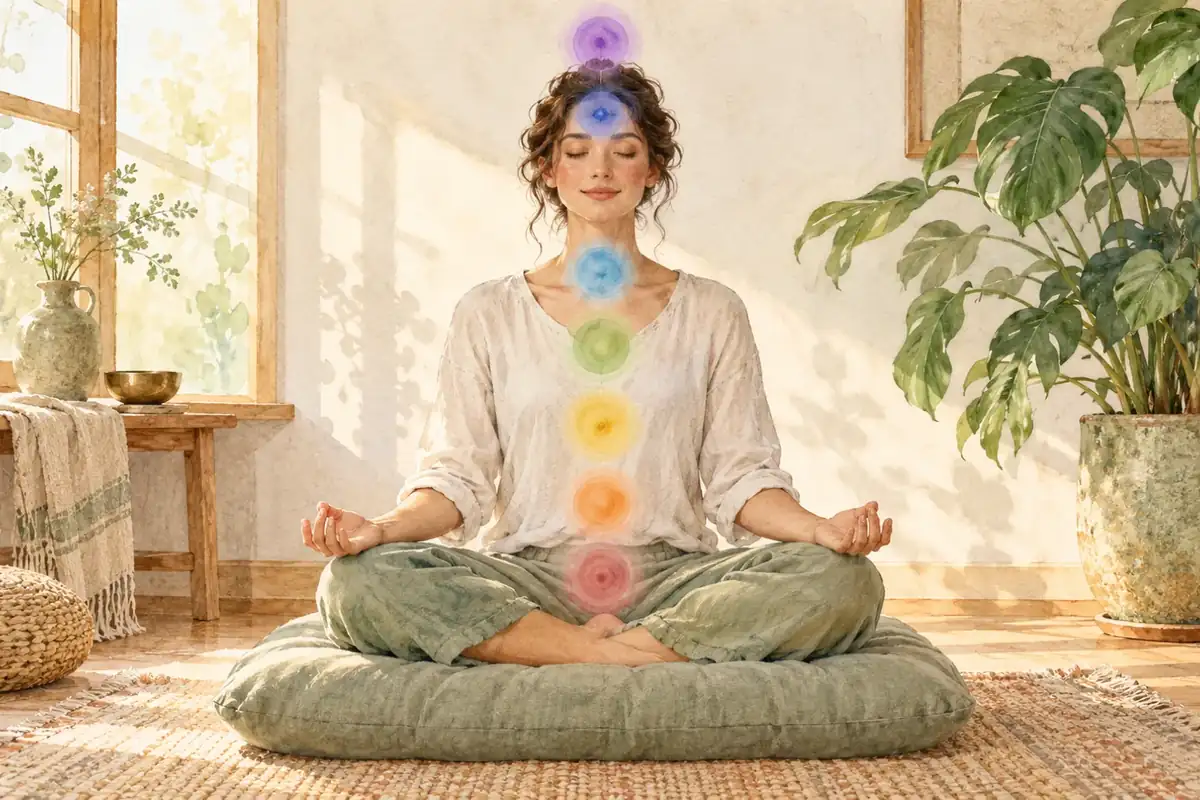
The locations below follow the seven-center description in Swami Rama’s Energy and Consciousness, published by the Himalayan Institute in 2019. Read them as locations within a spiritual teaching, rather than anatomical findings.
The reflection themes are prompts for this guide. The Himalayan Institute’s Chakras Back to Basics series, taught by Shari Friedrichsen, connects chakra practice with themes such as stability, heart-centered connection, and expression. That teaching resource describes beliefs and practice, not experimentally verified effects.
| Chakra | Spiritual location | Reflection prompt for this practice |
| Root or Muladhara | Base of the spine | What practical support do I need today? |
| Sacral or Svadhishthana | Pelvic region | What feeling can I acknowledge without judging it? |
| Solar plexus or Manipura | Navel region | What manageable action can I choose? |
| Heart or Anahata | Chest region | Where can I offer kindness with appropriate boundaries? |
| Throat or Vishuddha | Throat region | What do I want to express clearly? |
| Third eye or Ajna | Between the eyebrows | What am I noticing and what am I assuming? |
| Crown or Sahasrara | Top of the head | What gives my life meaning? |
Use the names if they help you follow the sequence. You can also remember it simply as base, pelvis, abdomen, chest, throat, forehead, and crown. The colored circles in the script and illustrations are optional visual cues chosen for this guide, not a claim that every chakra teaching uses the same colors.
How to prepare for a comfortable practice
Choose a chair, cushion, or supported resting position. If you use a chair, let your feet rest on the floor or another support. Adjust your position when needed rather than holding a painful pose.
Keep your eyes open, softly lowered, or closed according to comfort. Leave your breathing at its usual pace. This script does not call for breath holding, rapid breathing, or straining to make air reach an imagined center.
Set aside roughly ten minutes if that fits your day. This is a suggested practice length, not a research-backed dose. A shorter version is fine: choose one point of attention, read its passage, and finish.
For related reading, see LifeNByte’s beginner’s guide to meditation.

Guided chakra balancing meditation
Read slowly, pausing wherever you want. The passages below are original guidance from the LifeNByte Editorial Team. Optional phrases are suggestions for self-reflection, not quotations from a teacher or promises about what will happen.
Start by looking around the room. Notice where you are sitting and the support underneath you. Let your hands rest wherever they feel comfortable.
Take a moment to notice an ordinary breath. You do not need to deepen it. If your mind moves to a task, memory, or worry, acknowledge that and return to the part of the practice you have chosen.
Root chakra meditation for a sense of support
Bring attention to the contact between your body and the chair, cushion, or floor. You can focus on your feet instead of the base of your spine. Notice pressure or contact without searching for a special signal.
If imagery helps, picture a small red circle at the base of your body. Treat it as an imagined symbol. If you cannot picture it, stay with the contact beneath you.
Ask yourself what practical support you need today. Perhaps it is a meal, a break, a safer place to rest, or help with an unfinished task.
An optional phrase is: I can notice the support available to me. If that feels inaccurate, use a simpler sentence: My feet are resting here.
Sacral chakra meditation for acknowledging feelings
Move attention toward the lower abdomen or pelvic region, only if that feels comfortable. You can keep attention on your hands if this area feels too personal or uncomfortable.
Imagine an orange circle if you want. Notice whether a feeling is present without assigning it a chakra diagnosis. You might name it quietly as sadness, interest, frustration, or uncertainty.
If you do not notice an emotion, leave the question unanswered. If a difficult memory appears, you can leave this stage and look around the room.
Try the phrase: I can acknowledge this feeling without deciding what it means right now. Let the next breath happen normally.
Solar plexus chakra meditation for a manageable choice
Bring attention to the area around your navel. Let the abdomen move naturally with breathing, without pulling it in or pushing it out. A soft yellow circle can be an optional visual cue.
Choose one ordinary action that is within your control. It might be sending a message, preparing lunch, checking an appointment time, or declining a request you cannot meet.
Choose an action you could actually do after the practice, such as sending one message.
An optional phrase is: I can choose one manageable next step.
Heart chakra meditation for kindness with boundaries
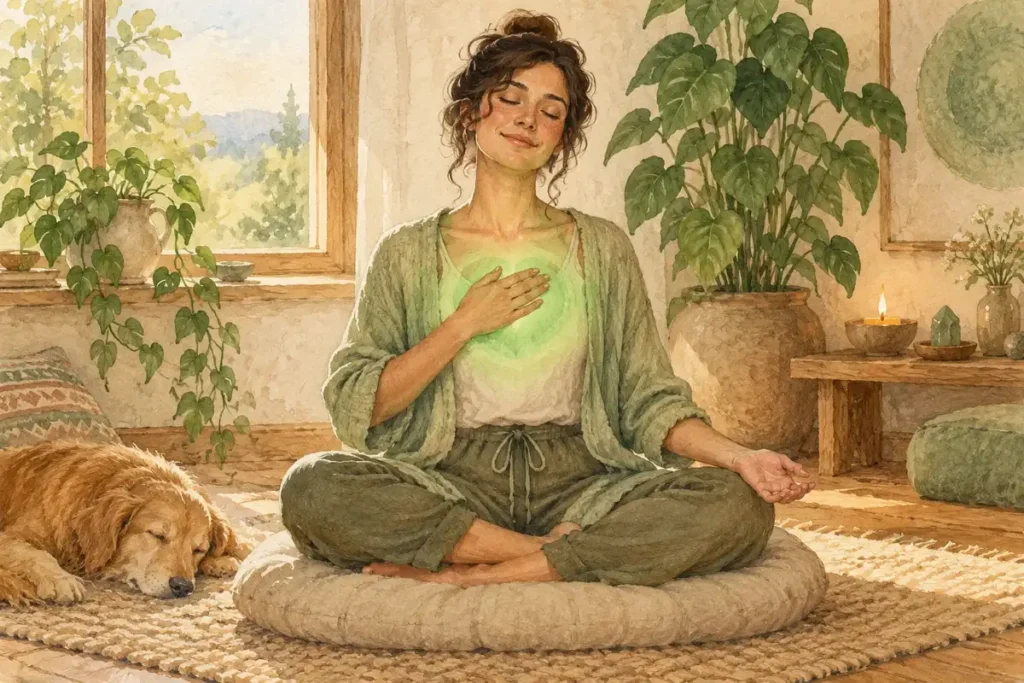
Bring attention to the chest area or to your hands resting in your lap. You may place a hand lightly on your chest if you find that comfortable. Imagine green light only if the imagery appeals to you.
Think of someone you care about, yourself, or a person you feel neutral toward. Offer a simple wish such as: May you have the support you need.
If you are wondering how to open your heart chakra after being hurt, use this stage to consider kindness that does not ask you to ignore what happened. Forgiveness and renewed contact are not requirements of the script.
You can care about someone while keeping a boundary. If the exercise brings up too much, return to noticing the room rather than continuing with the person in mind.
Throat chakra meditation for clear expression
Notice the throat area without tightening it. Let your jaw rest comfortably, and keep breathing normally. A blue circle may serve as an optional visual cue.
Consider something you want to communicate. It could be a preference, a question, thanks, or a boundary. Form a sentence that the other person could understand without needing to guess your meaning.
For example: I cannot take that on this week. Or: I would like some time to think before answering. These are communication examples, not chakra mantras.
You can say the sentence silently. Chanting is optional, and this practice does not require a particular pitch, recording, or sound frequency.

Third eye meditation for noticing assumptions
Bring attention toward the space between your eyebrows, or choose a spot in front of you. Avoid squinting or forcing your eyes upward. You may imagine an indigo circle, or leave out color entirely.
Notice one thought that has occupied you today. Consider which part is an observation and which part is a prediction or interpretation.
For example, an unanswered message is something you can observe. The idea that the person dislikes you is an interpretation unless you have other information.
Try the phrase: I can leave room for what I do not know. This stage asks for reflection, not psychic insight or certainty about another person’s thoughts.
Crown chakra meditation for meaning
Bring attention to the top of your head or to the space around your body. You may imagine violet or white light as a personal symbol.
Ask what you want to make time for beyond today’s immediate demands. Your answer may involve faith, family, service, creativity, or the natural world. You can also leave the question unanswered.
You can spend a quiet moment with a prayer or a personal value. Alternatively, notice a sound in the room and let the question rest.
End by looking around, moving your hands and feet, and noticing the surface underneath you. Stand when you feel ready.
How to balance chakras without chasing sensations
If you want to repeat the practice, choose a format you can comfortably use. A complete sequence is optional. You could spend one session with the root prompt about practical support and another with the throat prompt about communication.
Afterward, use these steps to connect the reflection with daily life:
- Note what you actually noticed, including an ordinary or uneventful experience.
- Write down one reflection that felt useful, without turning it into a diagnosis.
- Choose a practical action, such as asking for help or clarifying a boundary.
- Decide whether you want to repeat, shorten, change, or leave the practice.
If you enjoy repeated phrases, LifeNByte’s guide to Transcendental Meditation mantras and practice discusses another meditation approach. The reflection phrases here are not a substitute for instruction in that specific method.

When to pause or seek other support
Stop if you feel distressed or uncomfortable. Open your eyes, look around, change position, or leave the exercise. You do not need to interpret distress as a sign that the practice is working.
NCCIH’s 2022 overview notes that negative meditation experiences have been reported and that safety research remains limited. That official guidance supports taking discomfort seriously rather than assuming meditation is harmless for everyone.
For recurring symptoms, pain, or emotional difficulties that affect daily life, seek appropriate health care. Chakra language can express a personal belief, but it cannot establish why you have a symptom or which treatment you need.
Frequently asked questions
Start with a comfortable position and one point of attention, then move through the sequence if you want. Use the script as an optional spiritual or reflective exercise, without trying to create a particular sensation. After a short session, consider what felt comfortable and what you would change.
This guide provides no diagnostic test for blocked chakras. Feeling worried, tired, or reluctant to speak does not by itself identify a chakra problem. Describe the difficulty directly and consider practical support or health care when needed.
Within a spiritual practice, you can use the heart passage to reflect on kindness and connection. You do not have to forgive someone, resume contact, or force yourself to feel loving. Choose a reflection that respects both your feelings and your boundaries.
Try the throat passage and form one clear sentence about what you want to communicate. Say it silently or aloud if comfortable. This offers a reflection exercise rather than evidence that a physical center has opened.
Yes, you can use it as a question about meaning or values. Leave out imagery or religious language that does not fit your outlook. You can also skip that stage altogether.
Try a few minutes or roughly ten minutes for the full sequence, according to comfort and available time. These are practical suggestions, not a scientifically established duration for balancing chakras. Stop or shorten the session whenever you need to.
No equipment is required for this script. Colors are optional imagined cues, and you can practice in silence. Crystals or music may have personal meaning, but the meditation findings cited here do not establish that those additions balance chakras.
Use ordinary contact sensations, a spot in the room, or the reflection questions instead. Decide whether the practice is useful based on your experience rather than a checklist of expected sensations.
Bottom line
Chakra balancing meditation can provide a spiritual structure for attention and reflection. Try a comfortable version, keep imagery optional, and follow any useful reflection with a practical action. Goyal and colleagues’ 2014 review in JAMA Internal Medicine supports some symptom benefits from meditation programs, but it does not establish that this script balances chakras.