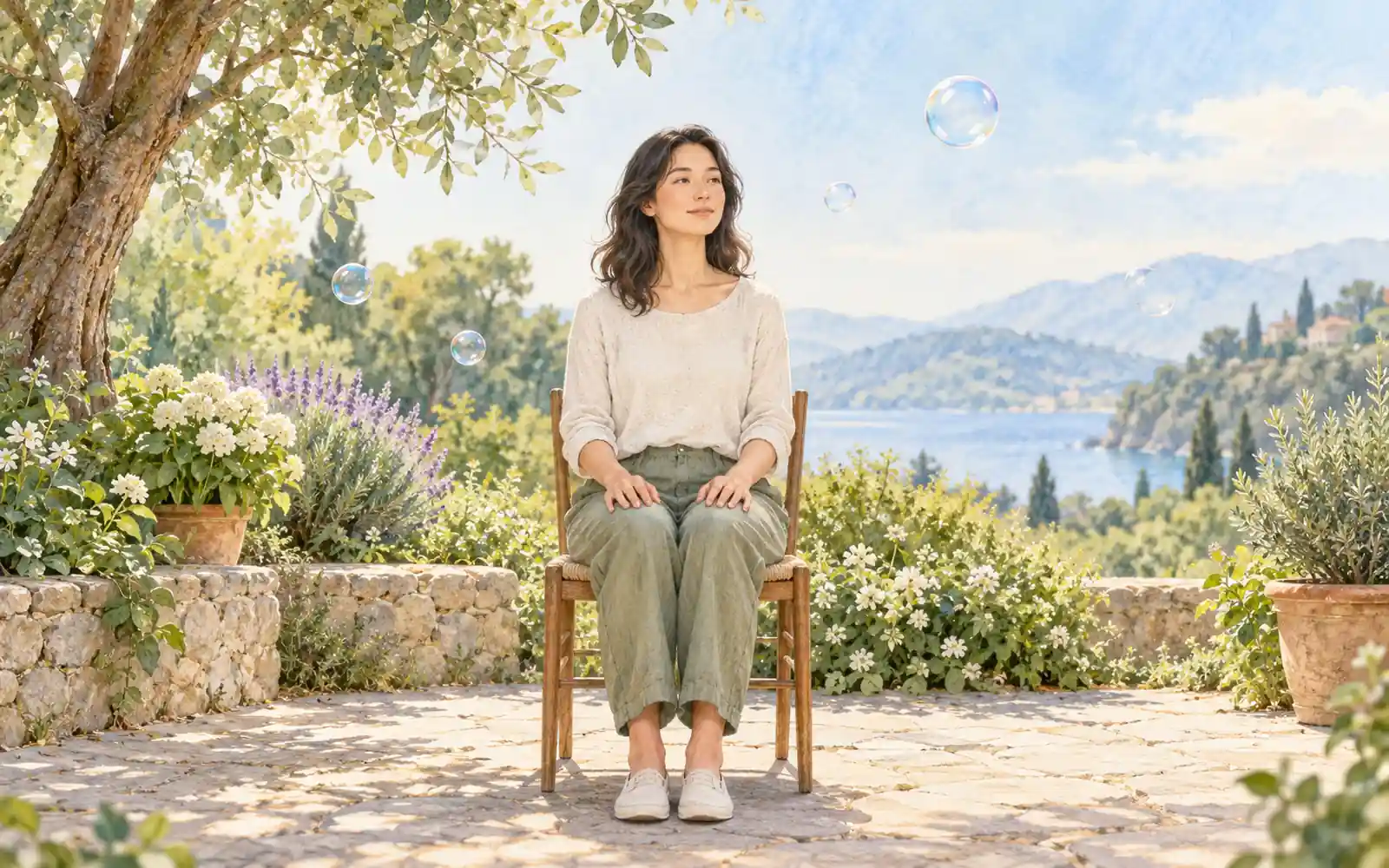
The bubble meditation on this page uses an imagined bubble to hold a short description of a thought and then drift out of view. You let a thought be present without trying to solve it, then return attention to a simple image or to the room around you. The script below uses that metaphor; it does not promise to remove thoughts or treat anxiety.
You can also choose a rainbow, beach, mandala, moon, nature, lotus, or sky practice. Start with whichever scene feels ordinary and comfortable to you. You do not need to work through all eight.
How to use these guided visualization meditation scripts
Read your chosen script once before beginning. You can remember its main idea, record yourself reading it slowly, or ask someone to read it aloud. Keep your breathing comfortable rather than matching it to a count.
Each italic pause cue marks a moment to stay with the image or notice your surroundings. You can pause briefly, stay longer, or end the exercise. These timings are flexible; the scripts do not specify a treatment duration.
- Sit or lie somewhere you can remain comfortably supported. Practise while stationary, away from tasks that need your attention.
- Keep your eyes open, partly open, or closed, whichever feels comfortable.
- Use the scene loosely. A word, sound, or idea can replace a detailed picture.
- When you notice you have started planning or judging the exercise, return to one detail of the scene.
- Finish by noticing the actual room, moving your hands, and taking your time before standing.
If this is your first practice, LifeNByte’s beginner’s guide to meditation offers another place to start.
Choose a scene you can comfortably stay with
Use the table to choose a scene or an alternative focus. It describes the instructions in these scripts; it does not rank them as treatments.
| Practice | What you attend to | An alternative if imagery is difficult |
| Bubble | A thought inside a drifting bubble | Say “thinking” and feel the chair beneath you |
| Rainbow | One colour at a time | Look at a coloured object in the room |
| Beach | Shoreline, sound, and dry sand | Notice an actual sound nearby |
| Mandala | A simple pattern and its edges | Use a plain circle on paper |
| Moon | A quiet imagined evening | Look at an ordinary stationary object |
| Nature | One tree and the ground around it | Feel your feet on the floor |
| Lotus | A flower resting on a pond | Notice a real plant or its photograph |
| Sky | Open space and passing clouds | Follow sounds as they begin and end |
Bubble meditation for thoughts that keep returning
Use this as an observation exercise. The aim is not to trap, erase, or dismiss an important concern.
Settle into your seat. Notice where it supports your back and legs. Let your breathing continue at its own pace. Pause.
Imagine a small, transparent bubble in front of you. It can be almost colourless, with just an edge catching the light. A rough idea of a bubble is enough. Pause.
If a thought appears, place a short description inside it: an appointment, a memory, or tomorrow’s work. You do not have to finish the thought. Let the bubble drift across the scene. Pause.
If the thought returns, notice that it returned. You can use another bubble, or leave the image and feel the support beneath you. There is no number of thoughts to clear. Pause.
Let the scene fade. Notice an actual sound and the position of your hands. End here, or write down anything that needs practical attention later.
Rainbow meditation with one colour at a time
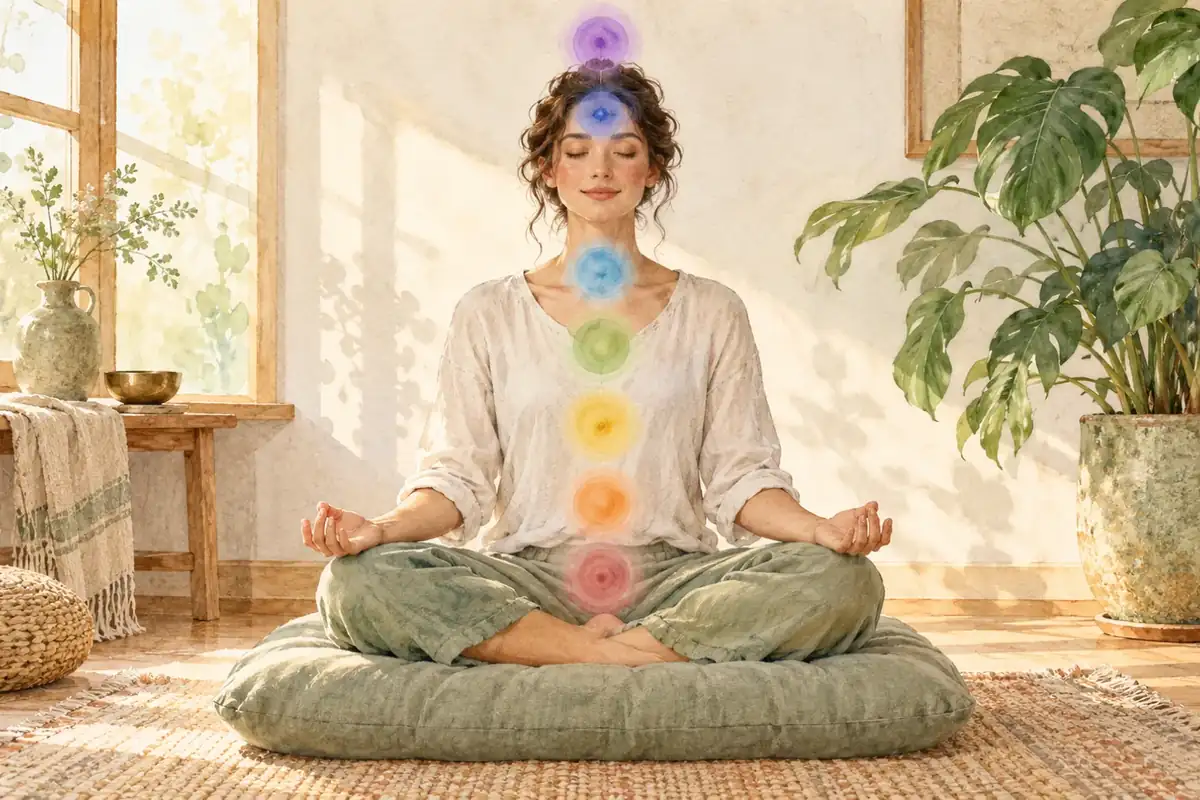
This version uses colour as a focus. It does not assign healing powers to colours or require a chakra system.
Find a supported position. Notice your feet, your hands, and one sound around you. Pause.
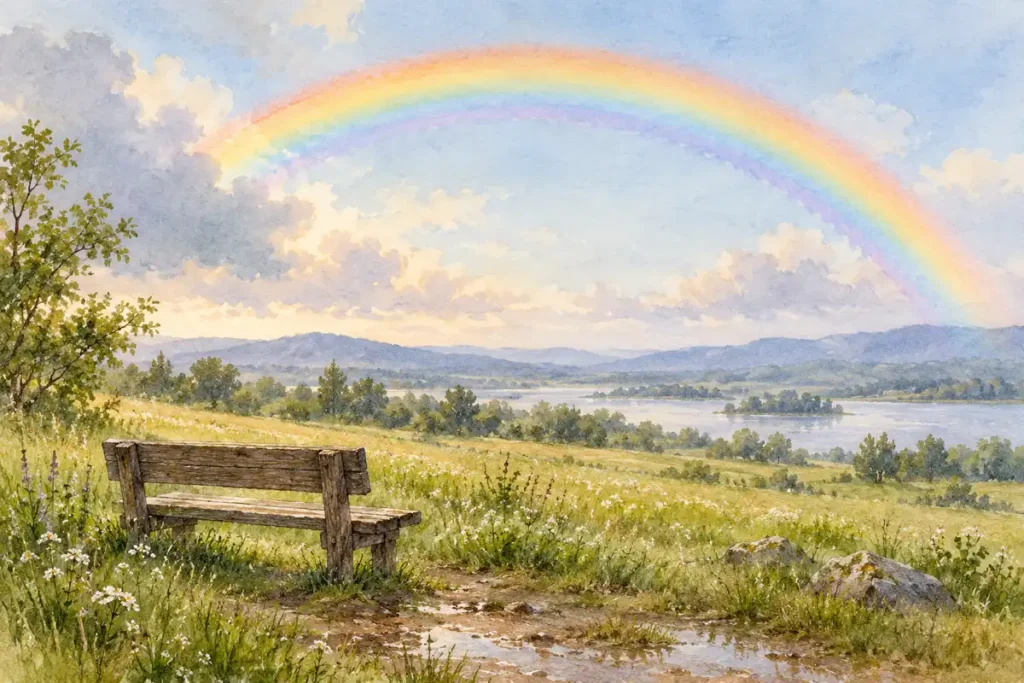
Imagine a soft rainbow after rain. Begin with any colour you can readily think of. Notice whether it seems pale, bright, warm, or cool. You can simply name the colour if no picture appears. Pause.
Move to another colour. Stay with one small detail rather than trying to assemble a perfect rainbow. Perhaps you think of the green of a leaf or the blue of a familiar cup. Pause.
If attention moves to something else, return to the colour you last remember. You may repeat a colour or skip one. The order is unimportant here. Pause.
Let the rainbow go. Find one colour in the room where you actually are, and rest your eyes there before continuing your day.
Beach meditation and a gentle ocean scene
Stay on the shore in this script. If water imagery makes you uneasy, choose the nature or mandala practice instead.
Imagine sitting on dry sand, well above the waterline. Notice the solid ground supporting you. The sea is at a comfortable distance. Pause.
Picture a small wave arriving and receding. Let it move at its own pace; your breathing does not need to follow it. You remain on the shore. Pause.
Choose one other detail: the sound of water, a rounded stone, or a patch of light on the sand. Let that detail be your focus for a little while. Pause.
If a thought interrupts, notice it and return to the shoreline. You do not have to send worries out to sea or imagine them being washed away. Pause.
Let the beach become less distinct. Feel the chair, floor, or bed supporting you now. Move your fingers and look around the actual space before finishing.

Mandala meditation with your eyes open
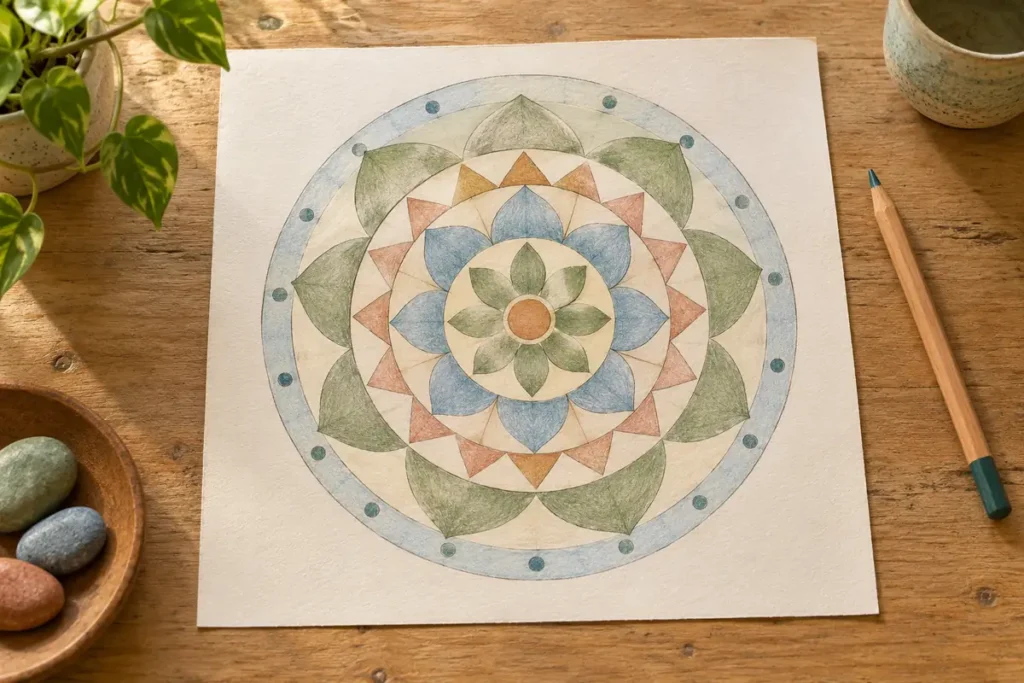
For this version, use a simple circular pattern on paper or a screen. Choose one that is easy to look at without strain; it need not be an elaborate design or a sacred object.
Place the pattern where you can see it comfortably. Let your eyes rest near the centre without fixing a hard stare. Pause.
Notice one line or shape. Follow its edge slowly with your eyes, then return to the centre. Choose a detail you can see without leaning forward or straining. Pause.
Choose another detail: a space between shapes, a repeated curve, or a colour. Let your gaze move naturally rather than trying to hold it still. Pause.
If you start judging the pattern or wondering whether you are concentrating enough, return to a visible edge. Blink, look away, or stop if your eyes feel tired. Pause.
Finish by looking at something else in the room. Notice how far away it is, and let your eyes move normally again.
Moon meditation and a new moon variation
Use the moon as an imagined object, not a source of energy or a prediction. A new moon can be a personal symbol for beginning again, but that is an interpretation rather than a finding about health.
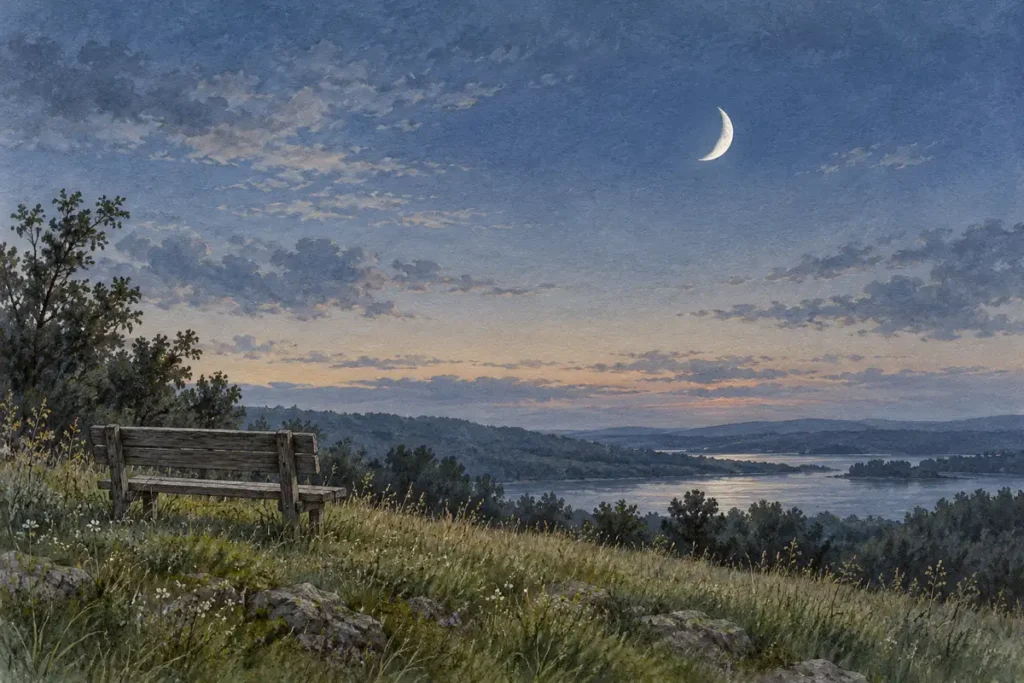
Imagine an evening sky viewed from somewhere comfortable. You are sitting on solid ground, with enough light to feel oriented. Pause.
Picture a small crescent moon. Notice its curve, then the space around it. You do not need to imagine light entering your body. Pause.
For a new moon variation, leave the moon out of view and attend to the quiet sky. If the symbolism matters to you, briefly name one ordinary intention, such as making time for lunch tomorrow. Pause.
Return to the sky without planning the whole next month. Let the scene remain simple. Pause.
Notice the room around you. If you chose an intention, decide later whether it needs a practical next step.
Nature meditation with a single tree
Choose an imagined place you would willingly visit. You might use a familiar park bench and the tree beside it.
Imagine standing or sitting near one tree. Notice the ground beneath it and the space between you and its trunk. Pause.
Choose a detail: the shape of a leaf, the texture of bark, or the shadow on the ground. You can remember how a tree feels without seeing it clearly. Pause.
Imagine a small movement in the leaves. Let the tree be part of an ordinary place, with distant sounds and changing light. It does not have to be perfectly silent. Pause.
If you find yourself planning a walk or remembering an argument, come back to the detail you chose. Stay there briefly, or change to another detail. Pause.
Let the imagined place recede. Feel your actual feet or hands, notice a nearby sound, and finish when ready.
Lotus meditation without a spiritual requirement
You may bring personal or spiritual associations to a lotus. This script asks only that you use a flower as a focus; it does not claim to open chakras or change an energy field.
Imagine a lotus resting on the surface of a small pond. You are observing from a comfortable place on the bank. Pause.
Notice the outline of a petal. Choose any colour, or leave the flower without a definite colour. A simple idea of its shape is enough. Pause.
Let your attention move from the petal to the water around it. There may be a small ripple or a reflection. You do not need to make the flower open. Pause.
If the scene changes on its own, let it change. Return to the flower when you remember, without rebuilding every detail. Pause.
Bring your attention to the surface supporting your body now. Look at something nearby and let the imagined flower go.
Sky meditation and a supported floating variation
This floating variation uses the image of a moving cloud while your body stays supported on a chair or bed. It is an imagery exercise on dry land and does not involve a flotation tank.
Notice where your body meets the chair or bed. Keep that contact in mind as you imagine an open sky. Pause.
Picture one cloud moving slowly across it. You can watch its edge change without choosing where it will go. Pause.
If a thought appears, imagine it passing with the cloud. You do not have to make it disappear. Return to the open space, or to the support beneath you. Pause.
For a floating meditation variation, imagine the cloud travelling while you observe from the ground. If you prefer, leave movement out entirely and use a still patch of sky. Pause.
Let the scene fade. Notice the weight of your hands and one object in the room. End with your attention back in the actual place where you are sitting or lying.
What the research supports and what it does not
The National Center for Complementary and Integrative Health (NCCIH, 2021) describes guided imagery as imagining objects, scenes, or events associated with calmness. Its relaxation techniques overview discusses research on several relaxation methods for specific conditions, with limitations in study quality. These are original LifeNByte scripts, not treatment protocols taken from those studies.
Research on a broader meditation programme should not be treated as a trial of a short bubble script. NCCIH’s 2022 meditation and mindfulness review notes that findings can be difficult to interpret because practices and studies differ. If you feel more settled after a script, you can note that response. It does not tell you whether the exercise would treat an anxiety disorder.
When imagery is difficult or uncomfortable
You do not have to produce vivid pictures. Adam Zeman, Michaela Dewar, and Sergio Della Sala described people with little or no voluntary visual imagery in their 2015 Cortex letter, Lives without imagery: Congenital aphantasia. This was a descriptive letter about imagery, not a meditation treatment trial. The sound and word options below are practical suggestions rather than adaptations tested in that paper.
Try naming an object, looking at a real pattern, or attending to a sound instead. If imagined scenes are unappealing, LifeNByte’s body scan meditation scripts offer a practice centred on actual sensations rather than invented scenery.
Stop if the exercise brings distress, intrusive images, or an uncomfortable sense of disconnection. Open your eyes, look around, and move if that feels helpful. NCCIH (2021) notes that relaxation practices can occasionally bring increased anxiety or intrusive thoughts in its safety guidance. Persistent symptoms deserve professional support rather than repeated attempts to push through a script.
Questions about bubble meditation and visualization
It is an imagery exercise that uses drifting bubbles as a metaphor for noticing thoughts. In this version, you give a thought a short description, let the imagined bubble move, and return to the scene or your surroundings. You are not expected to stop thinking.
These original LifeNByte scripts are optional exercises; no clinical trial results for them are presented here. NCCIH’s 2021 relaxation review discusses broader practices and limitations, not proof for this bubble exercise. Seek appropriate care if anxiety keeps affecting daily life.
Start by reading one script slowly, including the pauses. There is no established therapeutic duration for these original exercises. End earlier if you feel restless or uncomfortable, rather than trying to reach a target time.
Use a word, an idea, a real object, or a sound as your focus. Zeman and colleagues’ 2015 Cortex paper describes variation in voluntary imagery, so vivid pictures should not be a requirement here. These alternatives are practical adaptations, not tested treatments for aphantasia.
Yes; the mandala script is written for an open gaze, and the other scripts can be adapted that way. Keep your eyes comfortable and blink normally. You do not need to close them to follow the instructions on this page.
The rainbow script here focuses on colours without attaching bodily or healing claims to them. The colour prompts are independent of any chakra framework. You can use them simply to choose where to place your attention.
You can choose to read one while winding down, but it is not a promise that you will fall asleep. Keep the exercise optional and leave it if it makes you more alert. Recurring sleep problems need attention beyond choosing another visualization.
Stop using that scene and return attention to the actual room. NCCIH (2021) acknowledges occasional anxiety or intrusive thoughts with relaxation practices in its safety overview. If distress continues or repeatedly happens during practice, discuss it with a qualified professional.
Pick one image and leave room to adapt
Choose a scene you can stay with comfortably, and use only as much detail as you want. If bubbles become frustrating, try a real pattern, a sound, or the feeling of your feet on the floor. If one exercise feels comfortable, you can use it again. If none appeals to you, leave these scripts and choose another way to take a break.