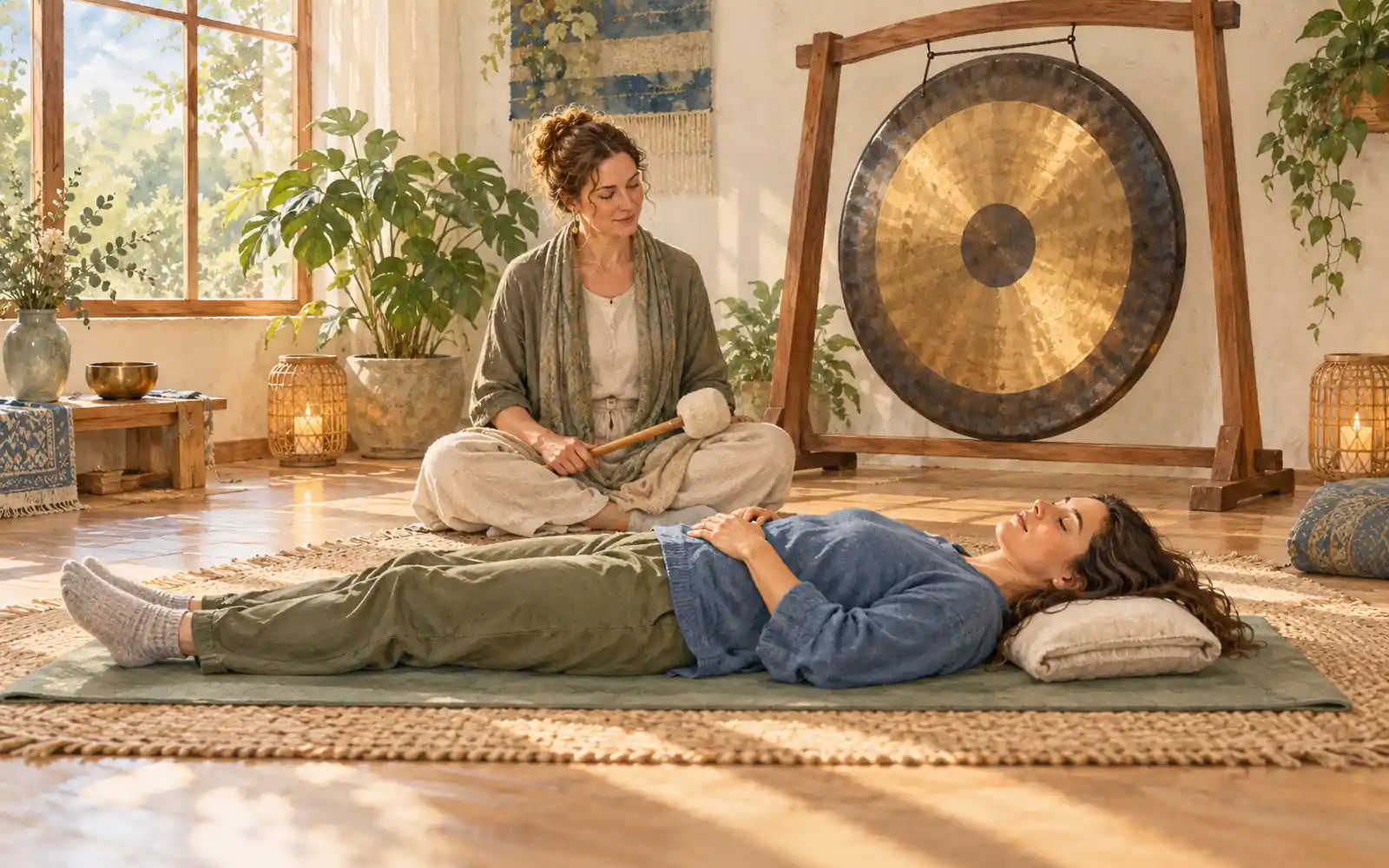
Yoga nidra is a guided meditation usually practised lying down, with attention moving through bodily sensations and other instructions while you aim to remain aware. It is sometimes called yogic sleep, but it is not a substitute for a night’s sleep. You do not need to perform yoga poses or make your mind completely quiet to try it.
A recording might invite you to notice your hands, listen to surrounding sounds or observe your breathing. Some versions include an intention or imagery; others use more neutral language. Before starting, preview the voice and instructions and choose a position you can rest in comfortably.
What yoga nidra involves
Moszeik, von Oertzen and Renner’s 2022 Current Psychology study, published online in 2020, describes yoga nidra as a sequence of perception exercises, typically done lying down. Attention may move between body parts and breathing rather than staying on one object throughout.
A teacher may call this movement of attention a rotation of awareness. You might hear a series of body parts named and briefly notice each one. There is no need to move that body part, visualise its anatomy or produce a sensation on command.
Some teaching includes a sankalpa, an intention for the practice. You can choose a simple intention, such as allowing yourself to rest, or leave that part out of a beginner exercise. An intention is not a guarantee that a health problem will resolve or that events outside your control will change.
Spiritual descriptions of consciousness or energy belong to the tradition or teacher’s framework. You can respect that context without treating those descriptions as measured clinical outcomes. Ask about the language used if you would prefer a secular recording.
Yoga nidra and non sleep deep rest
Non-sleep deep rest, usually shortened to NSDR, is a broader contemporary label. Huberman Lab’s NSDR guide, accessed October 2026, credits Andrew Huberman with coining the term and includes yoga nidra among the practices it covers. That page is useful for understanding the label; it is not a clinical trial of every recording marketed as NSDR.
The two terms overlap, but they do not specify an identical script. A yoga nidra guided meditation might include yogic terminology, an intention and imagery. An NSDR recording might use a body scan and plain instructions. Read the description or preview the audio rather than deciding by the name alone.
| Practice | What you are trying to do | What the label does not tell you |
| Yoga nidra | Follow guidance while resting and noticing experience | The exact sequence, teacher’s framework or tested health effects |
| NSDR | Follow a guided rest practice, often using bodily attention | Whether this particular recording has been studied |
| Nap | Take a period of sleep | Whether you will fall asleep or how you will feel afterwards |
| Quiet rest | Pause without following a script | Whether it will feel more comfortable than guided attention |
“Nap meditation” is another description you may encounter. Establish whether the recording aims to help you sleep or to keep you aware during rest. If you need to be up at a particular time, set an alarm independently of the audio.
What research shows about sleep and stress
A short recording led to small self-reported changes
Moszeik, von Oertzen and Renner’s 2022 Current Psychology study examined an 11-minute recording used over 30 days. Participants were randomly assigned to meditation or a waitlist. The meditation group reported improvements in stress and sleep quality, with very small to small effects.
Those were questionnaire outcomes, and the comparison did not receive an alternative active practice. The study therefore does not establish that yoga nidra works better than another equally credible guided break. It also does not prove that one session produces the same result as repeated practice.
Objective sleep findings need stronger confirmation
Datta and colleagues’ 2023 PLOS ONE pilot study recruited healthy young men without sleep disorders. After initial supervised training and continued practice, it found higher measured nighttime sleep efficiency and less wakefulness after sleep onset. It also examined cognitive tasks.
The study compared participants with their own baseline rather than with a separate active control group. That makes it difficult to separate practice effects from other changes during the study. This was not an insomnia treatment trial, and it does not establish that other recordings produce the same changes.
The newer review rated sleep evidence very uncertain
Singh and colleagues’ 2026 Sleep and Breathing systematic review and meta-analysis rated the evidence for sleep disturbances and insomnia as very low certainty. Its pooled randomized-trial analyses did not find statistically significant benefits on the Pittsburgh Sleep Quality Index or Insomnia Severity Index.
The authors highlighted small samples, risk of bias and differences between studies. The review leaves clinical effects uncertain; personal enjoyment of a session is a separate question. Research results also cannot be assumed to apply to the original script below, which has not been tested.
Can meditation replace sleep?
Yoga nidra should sit alongside your sleep schedule rather than shorten it. The US Centers for Disease Control and Prevention’s 2024 About Sleep guidance recommends at least seven hours for adults aged 18–60, with age-specific recommendations for older adults. None of the yoga nidra studies described above establishes a conversion between minutes of meditation and hours of sleep.
If you are trying it after a short night, preserve the next opportunity to sleep rather than using the session as permission to shorten another night. Feeling calmer after resting is a personal observation; it does not demonstrate that lost sleep has been replaced.
Similarly, do not use a completed recording as proof that you are ready to drive while sleepy. Arrange a safe alternative if you cannot stay alert. A guided rest exercise should not become a reason to ignore the circumstances that made you tired.
For persistent sleep problems, the CDC’s 2024 guidance advises speaking with a healthcare provider. Describe difficulties falling asleep, repeated waking and any daytime tiredness.
How to do yoga nidra for the first time
Choose a time when you can pause without needing to monitor a task. Practise in a safe place, away from driving, cooking or operating equipment. A short first attempt can help you decide whether you like the guidance before committing to a longer class.
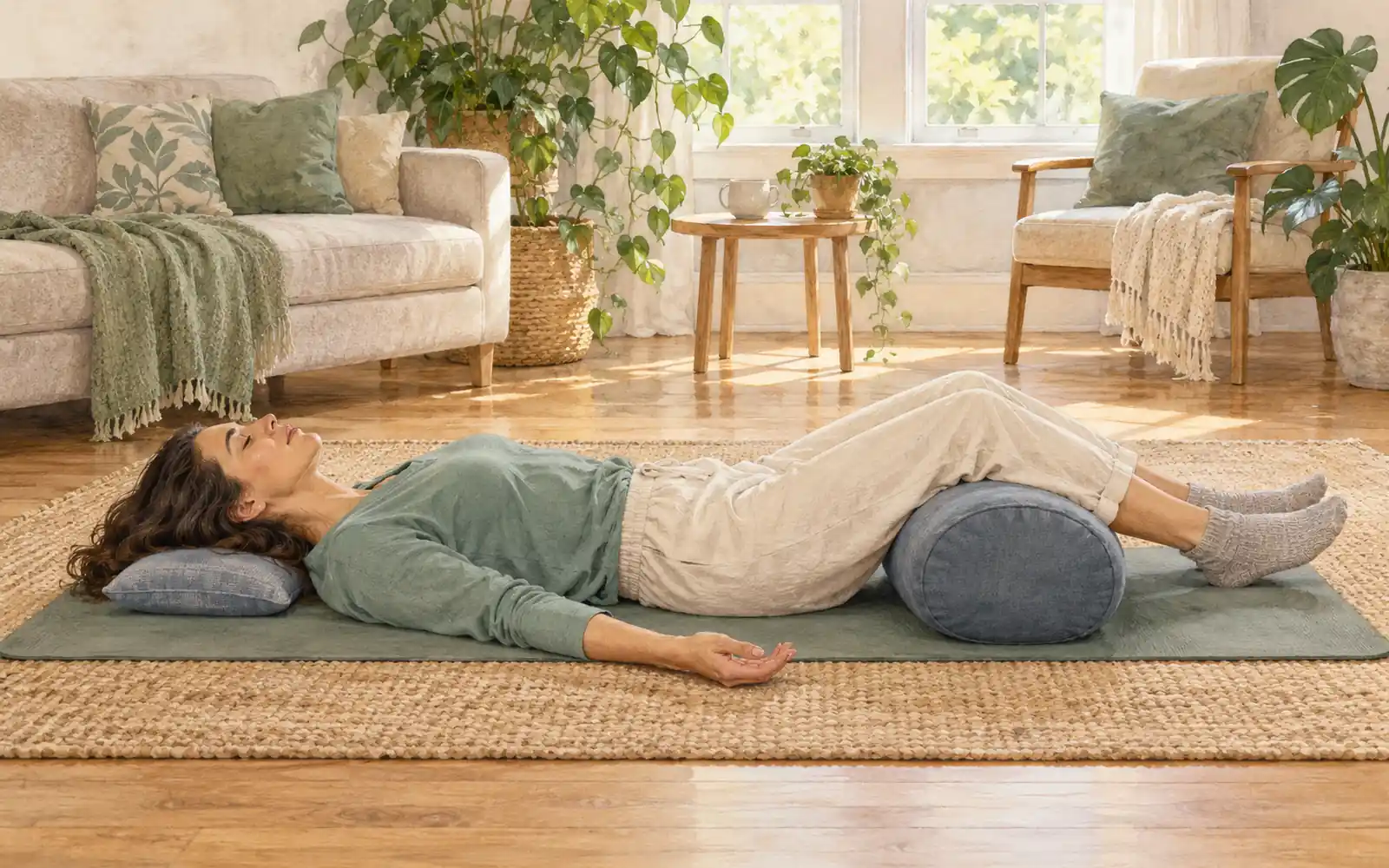
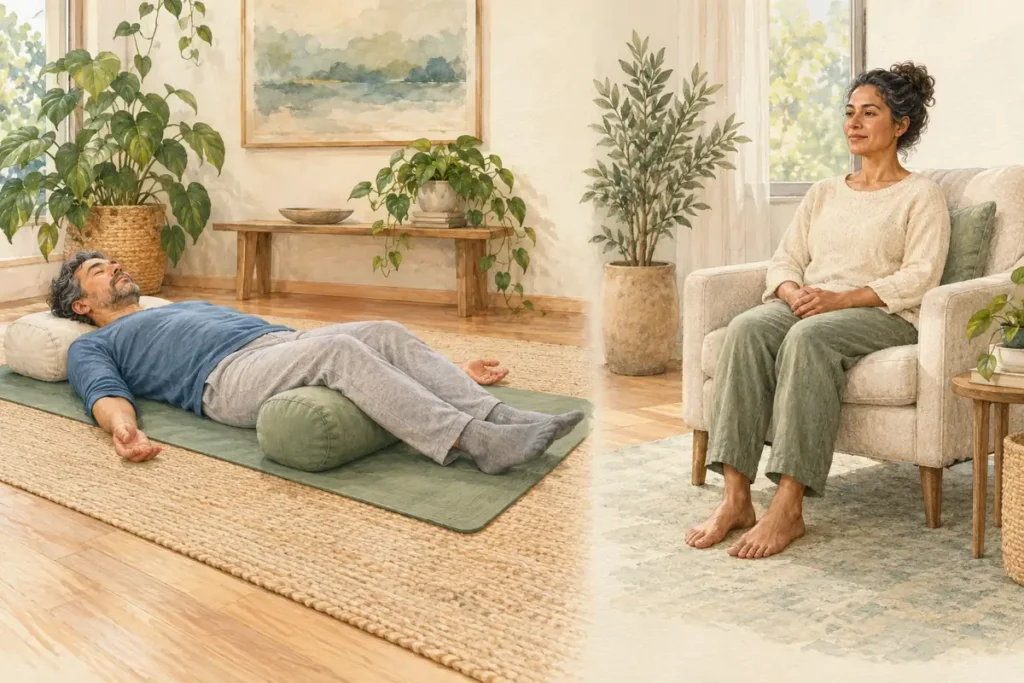
- Pick a supported position. Lie on a mat or another comfortable surface, or use a supportive chair. A pillow under your head or support beneath your knees is optional. Adjust the position if it hurts.
- Preview the guidance. Check the voice, pace, imagery and background sound. Avoid recordings whose claims or instructions make you uncomfortable.
- Keep the breathing ordinary. For this beginner exercise, you do not need deep breaths, counting or breath holds. Notice breathing only if that feels comfortable.
- Allow attention to move. If you miss a body part or lose track of the instructions, join the next instruction you hear. You do not need to restart.
- Leave yourself an exit. Keep the playback controls within reach. You can open your eyes, change position or stop at any point.
If focusing inward feels unpleasant, try noticing sounds in the room or the contact between your feet and the floor. You can also choose quiet rest without a recording. Do not push through an exercise just because it is described as relaxing.
A simple 10-minute yoga nidra inspired script
This is an original LifeNByte guided-rest exercise, not a quotation from a teacher or a validated treatment protocol. It uses simple bodily attention and an optional intention rather than presenting a complete method from a particular yoga nidra lineage. The timing is approximate: reading pace and quiet pauses will change the length.
Read it through first, then record it in your own voice if you want to follow it with your eyes closed. Allow quiet gaps within each stage. You can shorten a stage, skip it or finish early.
First minute: get comfortable
Find a position you can rest in without holding yourself rigidly. Let the surface beneath you support your weight. Adjust your head, shoulders or legs if you need to.
You can close your eyes, soften your gaze or keep looking at one place in the room. Notice a sound nearby. Then notice where your body meets the chair, mat or bed.
There is nothing you need to achieve before the next instruction.
Second minute: choose an optional intention
If you would like an intention, choose a short phrase that fits this pause. You might choose to give yourself a few quiet minutes. You can also leave out the phrase and simply continue resting.
Notice your breathing without changing it. If the breath is not a comfortable focus, stay with a sound in the room instead.
Minutes three to five: notice body parts
Bring attention to your right hand. Notice the thumb, fingers and palm without moving them deliberately. Notice the wrist, forearm, elbow and upper arm. Then notice the right shoulder.
Move attention to the left hand, its fingers and palm. Notice the left wrist, forearm, elbow, upper arm and shoulder.
Notice the right foot and toes, the ankle, lower leg, knee and thigh. Then move through the left foot, toes, ankle, lower leg, knee and thigh.
Notice the contact underneath your back or hips. Notice the abdomen, chest, neck and face. You do not need each area to feel different. If an area is uncomfortable to focus on, move on to another place or to a sound outside your body.
Minutes six and seven: notice ordinary breathing
If you wish, notice one place where you can feel the breath moving. It might be the abdomen or the air at the nose. Let the breath find its own pace.
When a thought takes your attention, return to the next sensation you notice. You do not need to finish the thought or argue with it. If breathing becomes something you are trying to control, return to the support beneath you.
Minutes eight and nine: rest with the whole body
Let the sequence of body parts end. Notice the body resting as a whole, or simply listen to the room. There is no need to inspect every sensation.
You may feel settled, distracted, sleepy or much as you did before. Let this part be a pause rather than a test of how relaxed you can become.
If you chose an intention earlier, bring it to mind once. Then leave some quiet space before finishing.
Final minute: return to the room
Notice the surface beneath you and the sounds around you. If your eyes were closed, open them when you are ready. Move your fingers and feet if that feels comfortable.
Take your time changing position. Before standing, check that you feel steady. Decide whether you want to continue resting or return to what comes next.
Using yoga nidra guided meditation at bedtime
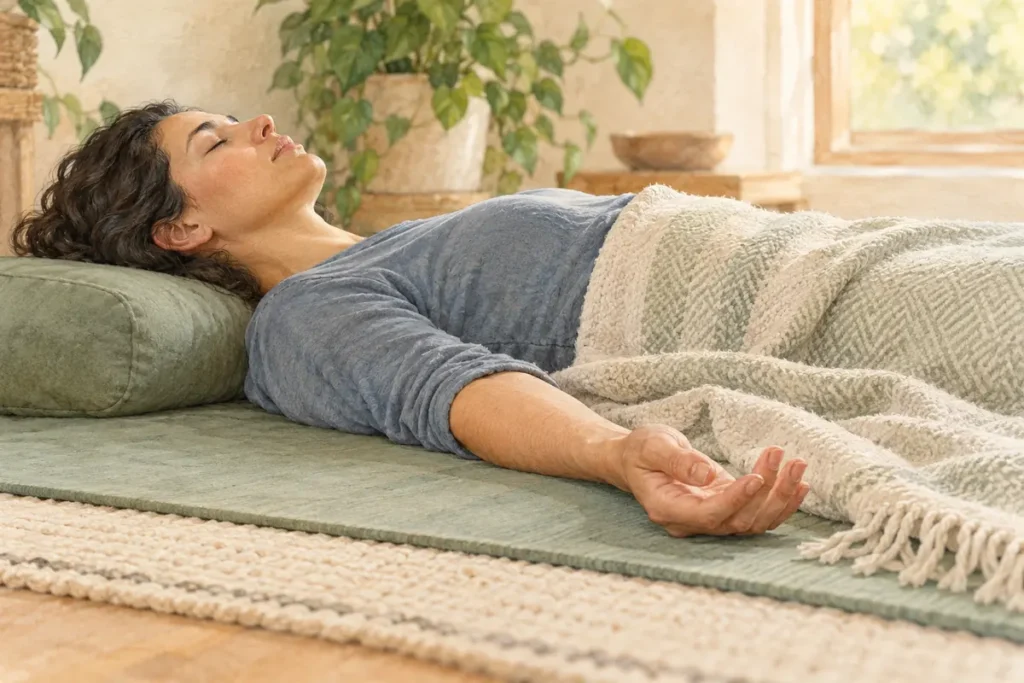
If your aim is to wind down before sleep, choose guidance that does not require you to finish in an alert seated position. Arrange the audio before settling down. Check for advertisements, sudden music changes or an ending that might disturb you.
For other approaches, LifeNByte’s sleep meditation guide compares guided and self-directed practice. If you want a shorter starting point, the five-minute meditation script offers another format. These are options to explore, not promises that a particular script will put you into deep sleep.
If listening makes you monitor your progress, become frustrated or keep checking whether you are asleep, pause the recording. You can stop the audio and settle down in silence.

Questions about yoga nidra and NSDR
These search terms usually refer to yoga nidra. Check the description to see what the teacher actually offers. The spelling does not specify a script, duration or clinical benefit.
Following the guidance while remaining aware is the aim of this exercise. If you lose track or fall asleep, you do not need to treat that as failure. If staying awake matters to you, try a supported seated position or a different time.
You can use a chair for the beginner exercise here. Choose support for your back and a stable position for your feet. Ask a class teacher about adaptations before booking if the session assumes everyone will lie down.
You can briefly notice the idea of that area and continue to the next instruction. Do not strain to create tingling, warmth or another sensation. If the exercise feels awkward, use sounds or the contact with the chair as your focus instead.
The studies discussed here do not establish a best length for every NSDR recording. Our approximate 10-minute exercise is an editorial starting point, not a proven minimum dose. You can finish sooner if the exercise becomes uncomfortable.
A cure is not established by the evidence discussed here. Singh and colleagues’ 2026 Sleep and Breathing review rated the sleep evidence very low certainty. If sleep problems persist, discuss them with a healthcare provider.
No special equipment is required for the original exercise here. You can use a speaker, read the sequence beforehand or record yourself. Choose audio you can hear comfortably and keep controls accessible.
Open your eyes, move, change the focus or stop. You do not have to continue inward attention or imagery that feels distressing. If this happens repeatedly and you still want to explore the practice, discuss suitable adaptations with a qualified professional.
Give rest a place alongside sleep
If you want to try yoga nidra, preview a recording or use the short script above. Choose a supported position and stop or adapt any instruction that feels uncomfortable. Notice whether you want to practise again, while keeping your usual opportunity to sleep.