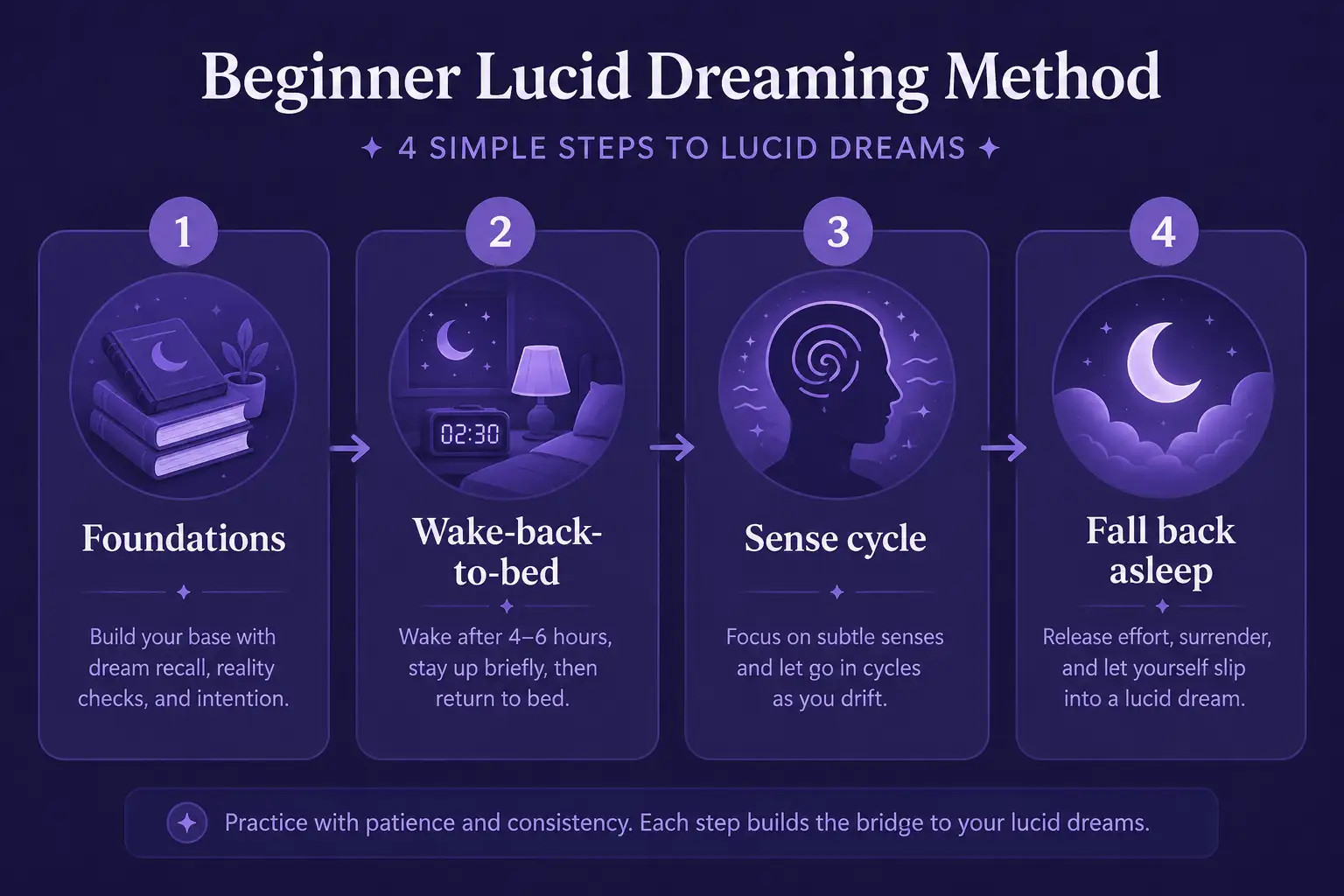
SSILD (Senses Initiated Lucid Dream) is a lucid dreaming technique in which you wake up about five hours into the night, cycle your attention through sight, sound and body sensation a handful of times, and then simply go back to sleep. It was created in 2013 by Gary Zhang, and alongside MILD it is one of the few home techniques with published results behind it. In the largest study of it, people who practised SSILD for a week had a lucid dream on 16.9% of nights, up from 4.7% in their baseline week. That is about the same as the better-known MILD technique.
This guide gives you the exact version that was tested, the timings, a guided card you can keep open on your phone at 4 a.m., and what the study data says about the small decisions that trip people up. Should you get out of bed? Does falling asleep mid-cycle ruin it? Is more cycling better? The answers are not what most forum advice assumes.
Key Takeaways
- The tested method: alarm about 5 hours after bedtime, 4 fast cycles (2–3 seconds per sense), 4–6 slow cycles (about 20 seconds per sense), then go to sleep normally.
- It works about as well as MILD. Lucid dreams on 16.9% of nights in the practice week, against 4.7% at baseline, among 76 people in the International Lucid Dream Induction Study (Aspy, 2020).
- More is not better. In that study, doing more fast cycles, or spending longer on the technique, was weakly linked with lower success.
- Falling back asleep quickly matters. Across all techniques, nights when people fell asleep within 10 minutes produced lucid dreams 18.3% of the time, against 11.1% when it took longer.
- Some worries don’t matter. Turning the light on, getting out of bed, or dozing off halfway through the cycles made no measurable difference.
- Still early evidence. A 2023 systematic review calls SSILD a promising technique that still needs replication (Tan & Fan, Journal of Sleep Research).
What is SSILD?
SSILD stands for Senses Initiated Lucid Dream. The double S is intentional. The technique was published online in 2013 by Gary Zhang, who posts as CosmicIron, and it spread through lucid dreaming forums long before any researcher looked at it.
The idea is simple. You interrupt your sleep in the second half of the night, when REM sleep (the stage with the most vivid dreams) is richest. While you drift back off, you move your attention between three senses in turn: what you can see behind your closed eyelids, what you can hear, and what you can feel in your body. You don’t repeat a mantra, visualise anything or try to stay aware. You just cycle, then let go.
Why would that produce a lucid dream? Nobody has tested the mechanism directly. The ILDIS author offers one likely explanation: repeatedly directing attention to your senses raises your general awareness of perception, and some of that carries into REM sleep. That makes you more likely to notice that the scene around you is a dream. It fits with what people describe, but treat it as a hypothesis, not an established fact.
How to do SSILD, step by step
These are the instructions used in the International Lucid Dream Induction Study, which were written in consultation with the technique’s creator. Read them once during the day so you’re not learning them half-asleep.
- Go to bed as normal and set an alarm for 5 hours later. The study asked people to put the alarm somewhere they had to get up to switch off. If you struggle to fall back asleep, keep it next to the bed with a quieter tone instead. Our wake-back-to-bed guide covers the timing in more detail.
- When the alarm goes, stay calm and get comfortable. Go to the toilet if you need to. You want to be awake enough to follow the steps, not alert.
- Do four fast cycles. Each cycle is sight, then hearing, then body, spending only 2–3 seconds on each. Don’t count seconds precisely. These just get the rhythm going.
- Do four to six slow cycles. Same three senses, about 20 seconds each. At least four slow cycles is the part the study instructions stressed.
- Then stop and go to sleep the way you normally would. Don’t keep cycling, don’t watch for a dream, and don’t try to hold on to awareness.
- When you wake up, write down whatever you remember, before you move or check your phone. Good dream recall was one of the strongest predictors of success in the study. Our dream recall guide explains how to build it.
The three senses: a guided card
Keep this open on your phone (with the brightness right down) for your first few nights. The slow cycle is where most of the time goes.
Where your attention goesTime
Sight. Attention on the darkness behind your eyelids.Hold for 2–3 sec
Hearing. Attention on whatever you can hear.Hold for 2–3 sec
Body. Attention on sensations in your body.Hold for 2–3 sec
Where your attention goesTime
Sight. Look at the darkness behind your closed eyelids. Keep your eyes still and relaxed. You might see coloured dots, patterns or images, or nothing at all. Don’t try to see anything.Hold for ~20 sec
Hearing. Shift your attention to your ears. Traffic, wind, your heartbeat, a faint ringing, or silence. Whatever is there is fine.Hold for ~20 sec
Body. Shift to your body: the weight of the blanket, your heartbeat, the temperature of the air. You may notice tingling, heaviness, lightness or a spinning feeling. If you do, relax and observe it without getting excited.Hold for ~20 sec
After the last slow cycle, stop. Settle into your usual sleeping position and let yourself fall asleep.
If the body step feels familiar, that’s because it is close to the attention you use in a body scan. People who already practise body scan meditation often find the slow cycles easy to settle into.
What the research shows
SSILD has one substantial home study behind it, one systematic review that includes it, and one lab preprint. That is more than most lucid dreaming techniques have, and less than you would want.
The International Lucid Dream Induction Study (2020)
The ILDIS, run from the University of Adelaide and published in Frontiers in Psychology, followed 355 people who logged their sleep and dreams for a baseline week and then practised one of six technique combinations for a second week. All of them used a wake-back-to-bed alarm.
The SSILD group (76 people) went from lucid dreams on 4.7% of nights to 16.9%, a large effect (r = 0.51). The four MILD groups averaged 16.5%. The author’s conclusion is that SSILD and MILD are similarly effective. Adding daytime reality checks to MILD did not help: both of those groups did worse than MILD on its own. The hybrid that mixed SSILD with the MILD phrase showed no advantage over either technique used on its own.
A rate of 16.9% means roughly one lucid dream every six nights of practice. That is realistic and useful, but it is not “lucid tonight”. The study also had real limits. Of 1,618 people who started, only 355 finished both weeks, so the results apply best to highly motivated people. Everything was self-reported at home. And a week is a short window.
What the reviews say
A 2023 systematic review in the Journal of Sleep Research (Tan & Fan) looked at 19 studies from the previous decade. It concluded that MILD remains the most effective induction technique, and that SSILD, along with the drug galantamine, “might also be competitive candidates” that need replication. That is a fair summary: promising, backed by one good study, not yet confirmed by a second independent one.
A 2024 lab study, with a caveat
A multi-centre study led by researchers at Radboud University Medical Center in the Netherlands, posted as a preprint in 2024, combined SSILD training with sensory cues played during REM sleep through a wearable EEG headband, during morning naps. Signal-verified lucid dreams occurred in 65% of participants at the Dutch site and 45% at the Italian site. Those are striking numbers, but they come from an unreviewed preprint with no group that skipped SSILD. So they tell you SSILD can be part of a very effective lab setup. They don’t tell you how much SSILD contributed on its own.
What the data says about the details
The ILDIS logged how people actually practised, which lets you check some common assumptions against the data.
| Question | What the study found | What to do |
|---|---|---|
| Should I do extra cycles to make it stronger? | In the SSILD group, more fast cycles and more minutes spent on the technique were both weakly linked with lower success | Stick to 4 fast and 4–6 slow cycles, then stop |
| How fast do I need to fall back asleep? | Across all groups, 18.3% of nights produced a lucid dream when people fell asleep within 10 minutes, against 11.1% when it took longer | Keep the wake-up short and calm. Don’t turn it into a project |
| Should I turn the light on? | No difference either way | Lights off if you struggle to fall back asleep; on for a few minutes if you’re dropping off too fast to finish |
| Should I get out of bed? | No difference either way | Do whatever gets you back to sleep fastest |
| What if I fall asleep before finishing the cycles? | It happened on 70.7% of occasions, and it made no difference to success | Don’t fight it. Falling asleep mid-cycle is fine |
| Should I combine SSILD with MILD? | The hybrid showed no advantage over either technique alone, and had one of the lowest rates | Pick one technique and give it a fair run |
A caution on the first two rows: those correlations are weak, and the study ran many statistical tests, so treat them as direction rather than law. But they point the same way as the rest of the evidence. SSILD works by being light-touch, and adding effort doesn’t make it work better.
SSILD vs MILD, WBTB and FILD
| Technique | What you do | Evidence | Best for |
|---|---|---|---|
| SSILD | Cycle attention through sight, sound and body after a 5-hour alarm, then sleep | One large home study: 16.9% of nights; promising in a 2023 review | People who find mantras and visualisation effortful |
| MILD | Recall a dream, repeat the intention to notice you’re dreaming, visualise becoming lucid | Most replicated technique; about 16.5–20% of nights in the ILDIS | People comfortable holding an intention as they fall asleep |
| WBTB | The wake-up itself, 4–6 hours into the night | Not a technique on its own; every successful protocol above used it | Everyone: it is the platform SSILD and MILD run on |
| FILD | Tiny finger movements as you drift off, then a reality check | Forum technique; no published trial | A backup if SSILD doesn’t suit you |
For a single beginner plan that combines these, with a realistic timeline, see our guide to the easiest way to lucid dream. If you meditate already, we also looked at whether meditation helps you lucid dream.
Troubleshooting SSILD
- I can’t fall back asleep. This is the most common failure, and the one the data says matters most. Shorten the time you’re awake, keep the lights off, use a quieter alarm, and skip the fast cycles if they wake you up. On nights before an early start, don’t set the alarm at all.
- I fall asleep before I finish. That’s fine. It happened most of the time in the study and didn’t reduce success. If you can’t even reach the slow cycles, turn a light on for a couple of minutes first.
- Nothing happens after a week. Expect roughly one success in six nights at best, so a blank week isn’t unusual. Check your dream recall first. If you’re not remembering dreams, you won’t remember the lucid ones either.
- I got strange sensations and panicked. Vibrations, buzzing, heaviness, floating or brief sleep paralysis can happen during the transition into sleep. They’re harmless. The instruction is the same as in the cycle: observe them passively, and either they fade or they carry you into a dream.
- I’m tired the next day. The study found no drop in self-reported sleep quality, but any night-time alarm costs some sleep. Practise on two or three nights a week rather than every night.
Is SSILD safe?
For most people, yes. In the ILDIS, successful lucid dream induction had no adverse effect on self-reported sleep quality. The author notes that the excitement of a lucid dream may mask tiredness, though. A Northwestern University analysis of lucid dreaming forum posts (Mallett et al., 2022) found that negative experiences mostly came from failed induction attempts, or from lucid dreams with little control over the dream, rather than from successful lucid dreams. That is a good argument for not pushing SSILD every night. If you have insomnia or another sleep disorder, or a condition where sleep disruption is a known trigger, talk to a doctor before deliberately interrupting your sleep. For what a lucid dream is (and isn’t) a sign of, see what a lucid dream means.
Frequently asked questions
SSILD stands for Senses Initiated Lucid Dream. The double S in the acronym is intentional. The technique was published online in 2013 by Gary Zhang, who posts under the name CosmicIron, and it involves cycling your attention through sight, hearing and body sensations after waking in the night, then going back to sleep.
It has one substantial study behind it. In the International Lucid Dream Induction Study (Aspy, Frontiers in Psychology, 2020), 76 people who practised SSILD with a wake-back-to-bed alarm had lucid dreams on 16.9 percent of nights during their practice week, up from 4.7 percent in a baseline week. That was about the same as the MILD technique. A 2023 systematic review called SSILD promising but said it still needs to be replicated.
The version tested in research uses four fast cycles of 2 to 3 seconds per sense, followed by four to six slow cycles of about 20 seconds per sense, and then you go to sleep normally. Doing more is not better: in the 2020 study, extra fast cycles and more time spent on the technique were weakly linked with lower success.
Some people have a lucid dream within the first week, but the average rate in the main study was about one lucid dream every six nights of practice. Treat the first one or two weeks as a trial, keep a dream journal, and judge it on the number of lucid nights over several weeks rather than on any single night.
Neither has been shown to be better. In the 2020 study, SSILD produced lucid dreams on 16.9 percent of nights and the MILD groups averaged 16.5 percent. MILD has been replicated in more studies, while SSILD asks less of you mentally because there is no mantra or visualisation. Choose the one you find easier to do consistently, and don’t mix them: a hybrid of the two showed no advantage.
It has only been tested with a wake-back-to-bed alarm set about five hours after going to sleep, which puts the technique just before the longest REM periods of the night. Doing it at bedtime is untested and likely to work less well, because you would have several hours of sleep before your best chance of a lucid dream.
That is fine. In the 2020 study, people fell asleep while still doing their technique on 70.7 percent of occasions, and it made no difference to whether they had a lucid dream. What did matter was falling back asleep reasonably quickly, within about 10 minutes of finishing.
It does not seem to matter. In the 2020 study, neither turning the light on nor getting out of bed after the alarm was related to success. Do whatever helps you fall back asleep quickly: stay in the dark if you struggle to drop off, or turn a light on briefly if you keep falling asleep before finishing the cycles.
More on sleep, dreams and lucid dreaming in Sleep and Dreaming.