

A lucid dream is a dream in which you realise, while it is still happening, that you are dreaming. That realisation is the whole of what “lucid” means here – and it is a measurable brain state, not folklore.
It usually arrives as a jolt mid-dream: you are flying over a rainbow-colored ocean, dolphins leaping beside you, and a thought cuts through – wait, this cannot be real. That flash of awareness is the lucid moment. What it feels like and what it signifies are two different questions, and they get mixed up constantly. This guide separates them: what sleep-lab research has actually verified, how psychology and tradition interpret it, and what a lucid dream is – and is not – a sign of.
What Is a Lucid Dream? A Working Definition
A lucid dream is a dream in which you know, in the moment, that you’re dreaming, while you’re still asleep. You’re not awake and you’re not just recalling the dream afterward: you’re inside it, aware, and sometimes able to steer what happens next. It’s a real, measurable brain state, not folklore, and researchers have been studying it in sleep labs since the early 1980s.
How Is This Different From a Regular Dream?
- In a regular dream, you’re just along for the ride. Everything feels real, and you don’t question it.
- In a lucid dream, you become an active participant. You might redirect the plot, decide to fly, or talk directly to a dream character.
Think of it like the difference between watching a movie and playing a video game where you control the action.
A quick example:
You’re being chased by a giant squirrel. Instead of panicking, you realize: “Squirrels aren’t this big. I’m dreaming.” You stop running, and the squirrel turns into a friendly puppy.
That moment of recognition, and the choice that follows it, is what separates a lucid dream from an ordinary one. So what’s actually happening in your brain when that switch flips?
The Science: What’s Actually Happening in Your Brain
Lucid dreaming isn’t just a self-reported feeling. It has been directly verified in a sleep laboratory, and brain imaging shows it looks like a distinct physiological state, not just “a vivid dream.”
Verified in the Sleep Lab
In 1981, sleep researcher Stephen LaBerge and colleagues at Stanford ran a now-classic experiment: they had trained lucid dreamers agree, before falling asleep, to move their eyes in a specific left-right pattern the moment they became lucid inside a dream. Because eye muscles aren’t paralyzed during REM sleep the way most of the body is, the signal showed up on the lab’s polygraph in real time, while EEG confirmed the subjects were still genuinely in REM sleep. Five subjects successfully signaled lucidity this way, giving researchers the first objective, moment-by-moment marker of lucid dreaming (LaBerge, Nagel, Dement & Zarcone, 1981, Perceptual and Motor Skills).
The “Hybrid State”: What Brain Scans Show
A 2009 EEG study found that when dreamers became lucid, activity in the 40 Hz gamma range increased, especially in the frontal areas of the brain associated with self-awareness and logical thought, sitting somewhere between normal REM sleep and full waking activity. The researchers described lucid dreaming as its own distinct state of consciousness, part sleeping brain, part waking brain (Voss & Holzmann et al., 2009, Sleep). That lines up with what lucid dreamers describe: your body stays asleep and paralyzed, but the part of your brain responsible for self-reflection switches back on.
Why Does This Happen?
Researchers don’t have a single settled answer for why some people become lucid and others rarely do. A few things are well established: people who already have strong dream recall and a habit of noticing “dream signs” (odd, dreamlike details) are more likely to become lucid, and specific techniques like reality testing and Wake-Back-to-Bed reliably raise the odds in controlled studies. What lucid dreaming is for, evolutionarily or psychologically, is still an open question researchers are actively debating rather than a settled fact.
For the full step-by-step routine, see our guide to how to lucid dream fast, using the easiest beginner method.

How Psychology and Tradition Interpret Lucid Dreams
Outside the sleep lab, lucid dreams have been interpreted very differently depending on who you ask. Neither view below is a scientific claim; they’re two long-standing lenses people use to make sense of the experience.
The Jungian View
Psychologist Carl Jung viewed dreams as messages from the unconscious, built from recurring symbols and archetypes. In this framework, a lucid dream is a chance to consciously engage with those symbols instead of just passively experiencing them: noticing recurring imagery, sitting with a frightening dream figure instead of running from it, and treating your dream life as material worth reflecting on.
Spiritual and Cultural Traditions
Long before Western sleep labs existed, several traditions had their own frameworks for conscious dreaming. Tibetan Buddhist “dream yoga” treats lucid dreaming as a meditation practice, used to rehearse recognizing illusion while still inside an experience. Various Indigenous and mystical traditions have similarly described lucid dreams as a space for encountering guides or ancestors, or for confronting fears symbolically. These are belief systems, not empirical claims, and we’re not presenting them as verified fact, but they’re part of why lucid dreaming carries meaning for many people well beyond “an interesting sleep phenomenon.”
Curious how dreaming works more broadly? See Sleep and Dreaming: Why Your Brain Throws Midnight Netflix Parties.

Signs You Had a Lucid Dream
Not sure if what you experienced counts? Lucid dreams tend to share a few unmistakable features.
3 Tell-Tale Signs
- The recognition moment. You suddenly realize, mid-dream, that you’re dreaming, often triggered by something that doesn’t add up (a dead relative appears, gravity stops working).
- Some degree of control. You can change a detail, a scene, or your own actions, even partial control (deciding to walk somewhere instead of just being swept along) counts.
- Unusually vivid senses. Colors, textures, and sounds often feel sharper and more detailed than in a typical dream.
Key takeaway: Lucid dreams tend to feel sharper and more memorable than ordinary dreams, because you’re not just watching, you’re participating. Keeping a dream journal by your bed and jotting down anything vivid or unusual right after waking is the simplest way to start noticing your own patterns.

How People Learn to Lucid Dream (Short Overview)
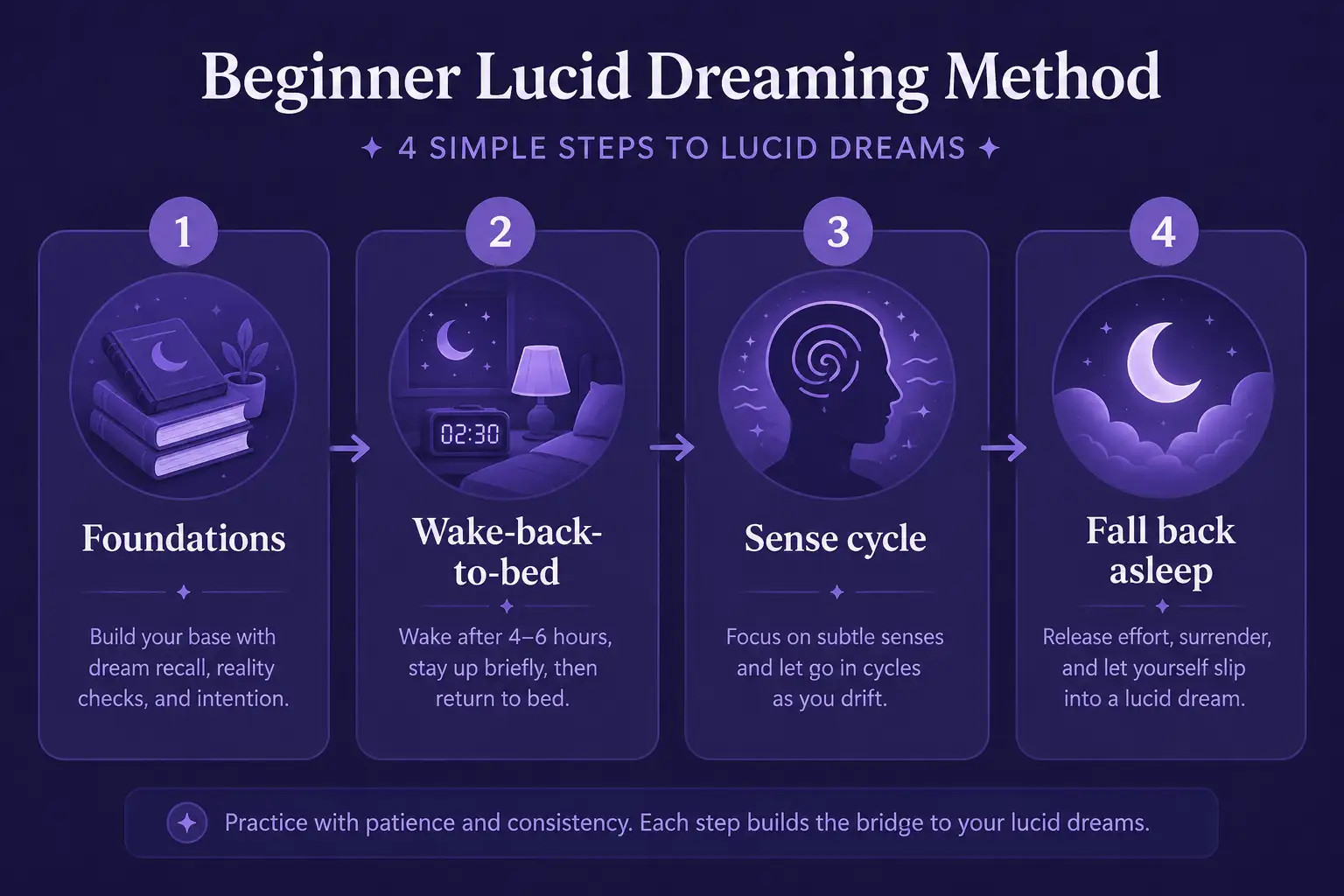
With practice, most people can learn to have at least an occasional lucid dream. The core techniques researchers and experienced lucid dreamers rely on are reality testing (questioning whether you’re awake several times a day, so the habit carries into your dreams), keeping a dream journal to build recall and spot recurring “dream signs,” and Wake-Back-to-Bed, where you wake briefly a few hours into sleep before returning to bed with the intention to stay aware.
Two things tend to work against beginners: forcing it (stress makes dreams harder to recall and control) and heavy caffeine or alcohol use, both of which disrupt REM sleep, the stage lucid dreams happen in.
We’ve written full, step-by-step walkthroughs of each method: the easiest way to lucid dream covers the beginner-friendly SSILD technique, and how to lucid dream fast walks through combining multiple techniques in one night.

Lucid Dream vs. Astral Projection: Key Differences
These two get confused often, but they describe different experiences.
| Aspect | Lucid Dreaming | Astral Projection |
|---|---|---|
| What happens | You’re asleep but aware you’re dreaming. | A reported sense of one’s consciousness leaving the physical body. |
| Control level | Often substantial control over the dream. | Typically described as an observer experience. |
| Scientific status | Verified brain state, studied via EEG and polygraph since 1981. | Not scientifically verified as literal separation from the body; understood by researchers as a vivid altered state. |
| Framework | Sleep science and psychology. | Primarily a spiritual/esoteric framework. |
The two experiences do share some overlap (both involve altered awareness and can feel intensely real), which is likely why people conflate them. One documented difference: people describing astral projection often report seeing their own sleeping body from outside it, a detail rarely reported in ordinary lucid dreams.

Is Lucid Dreaming Safe? What the Research Says
There’s no research linking lucid dreaming itself to physical harm in healthy sleepers. The body’s natural muscle paralysis during REM sleep (the same mechanism that stops you from acting out every dream) stays active whether or not you’re lucid, so becoming aware inside a dream doesn’t change your physical safety while you sleep.
There’s also a legitimate clinical use: the American Academy of Sleep Medicine lists lucid dreaming therapy as one of several recognized cognitive-behavioral approaches for chronic nightmares, and a 2023 systematic review found it helped reduce nightmare frequency in most of the studies reviewed, though the authors note the evidence base is still small and the studies vary in quality (systematic review, 2023, Sleep and Vigilance).
The Real, Manageable Concerns
| Issue | Why it happens | What helps |
|---|---|---|
| Sleep paralysis on waking | You surface from REM sleep before your body’s paralysis has fully switched off. | It’s temporary and harmless. Stay calm; it typically passes within seconds to a couple of minutes. |
| Vivid or unsettling dreams | Heightened awareness can make emotionally intense dream content feel more immediate. | Reminding yourself, “I’m dreaming, and I’m safe” tends to help in the moment. |
| Fragmented sleep | Overusing Wake-Back-to-Bed interrupts your normal sleep cycle. | Limit it to a night or two per week and prioritize full, uninterrupted sleep otherwise. |
The bottom line: for most healthy adults, lucid dreaming carries the same risk profile as ordinary dreaming. If you have epilepsy, a dissociative disorder, or a history of psychosis, talk to a doctor before deliberately inducing lucid dreams, since sleep disruption and altered states of consciousness can interact with those conditions in ways that haven’t been well studied.
FAQs – Quick Answers About Lucid Dreams
A: Yes. In a 1981 sleep-lab study, researchers verified lucid dreaming in 5 subjects who signaled they knew they were dreaming by moving their eyes in a pre-arranged pattern during confirmed REM sleep (LaBerge, Nagel, Dement & Zarcone, 1981, Perceptual and Motor Skills). It’s since been studied with EEG, not just self-report.
A: More common than most people assume. A 2016 meta-analysis of 34 studies found about 55% of people have had at least one lucid dream, and roughly 23% have them monthly or more often (Saunders et al., 2016, Consciousness and Cognition).
A: That’s normal, especially early on. Start small, changing one object or detail rather than the whole scene, and try to stay calm: excitement or fear is one of the most common reasons a lucid dream ends abruptly.
A: Honestly, we don’t know. Animals show REM sleep and brain activity that resembles dreaming, but confirming lucidity requires a subjective report, and there’s no way to get one from a non-verbal animal. It’s an open question, not an established fact.
A: Yes, they dream, typically built from sound, touch, smell, and movement rather than images, especially for people blind from birth. Whether lucid dreaming specifically is more or less common in this group hasn’t been well studied yet.
A: The real risk is sleep disruption, not “too much” lucidity. Techniques like Wake-Back-to-Bed involve deliberately interrupting sleep, and overdoing that can leave you groggy. There’s no evidence of a “dream addiction” risk for healthy sleepers.
On its own, it means your brain reliably produces enough self-awareness during REM sleep for you to notice you are dreaming. It is a normal variation in how people sleep, not a diagnosis, a talent, or a sign that something is wrong. The strongest correlate in the research is simply good dream recall – people who remember their dreams vividly are the ones most likely to notice a dream while it is happening.
Not of any medical or psychological condition. Lucid dreaming is common enough to be considered a normal part of human sleep, and the research links it mainly to dream recall and to how often a person questions their own experience while awake. It is not evidence of a disorder, and it is not evidence of a gift. Frequent lucid dreams that leave you unrested are worth mentioning to a doctor, but that is about sleep quality, not about lucidity itself.
That depends entirely on the tradition, and none of it is a scientific claim. Tibetan dream yoga treats lucidity as a practice for recognising the constructed nature of experience; several other traditions read it as contact with a deeper layer of self. Jungian psychology treats the dream as material from the unconscious rather than a message from outside it. These are interpretations, not findings – the sleep-lab research described above establishes that lucid dreaming happens and what the brain does during it, but says nothing about what it means.










3 thoughts on “What Does a Lucid Dream Mean? The Science and the Signs”