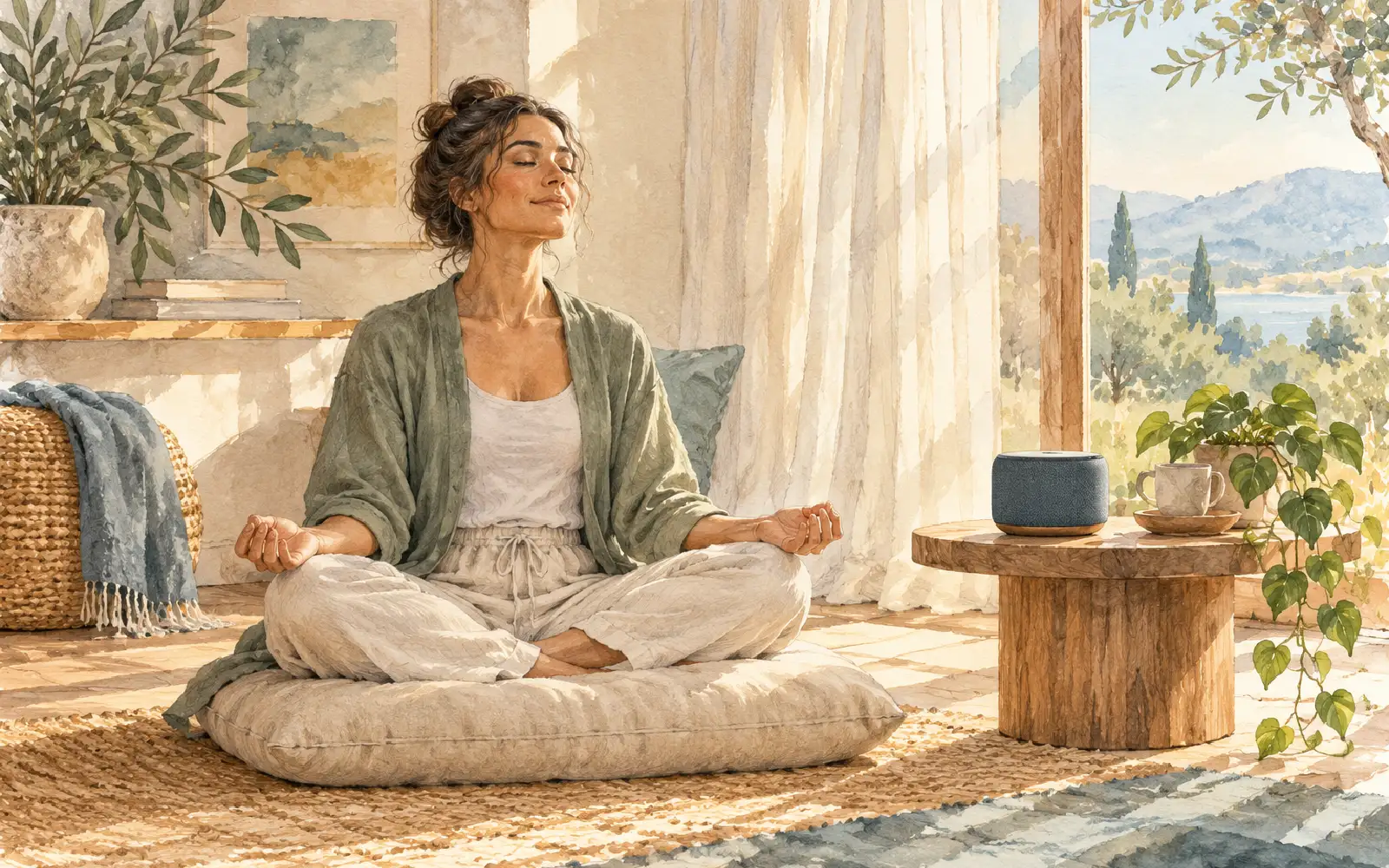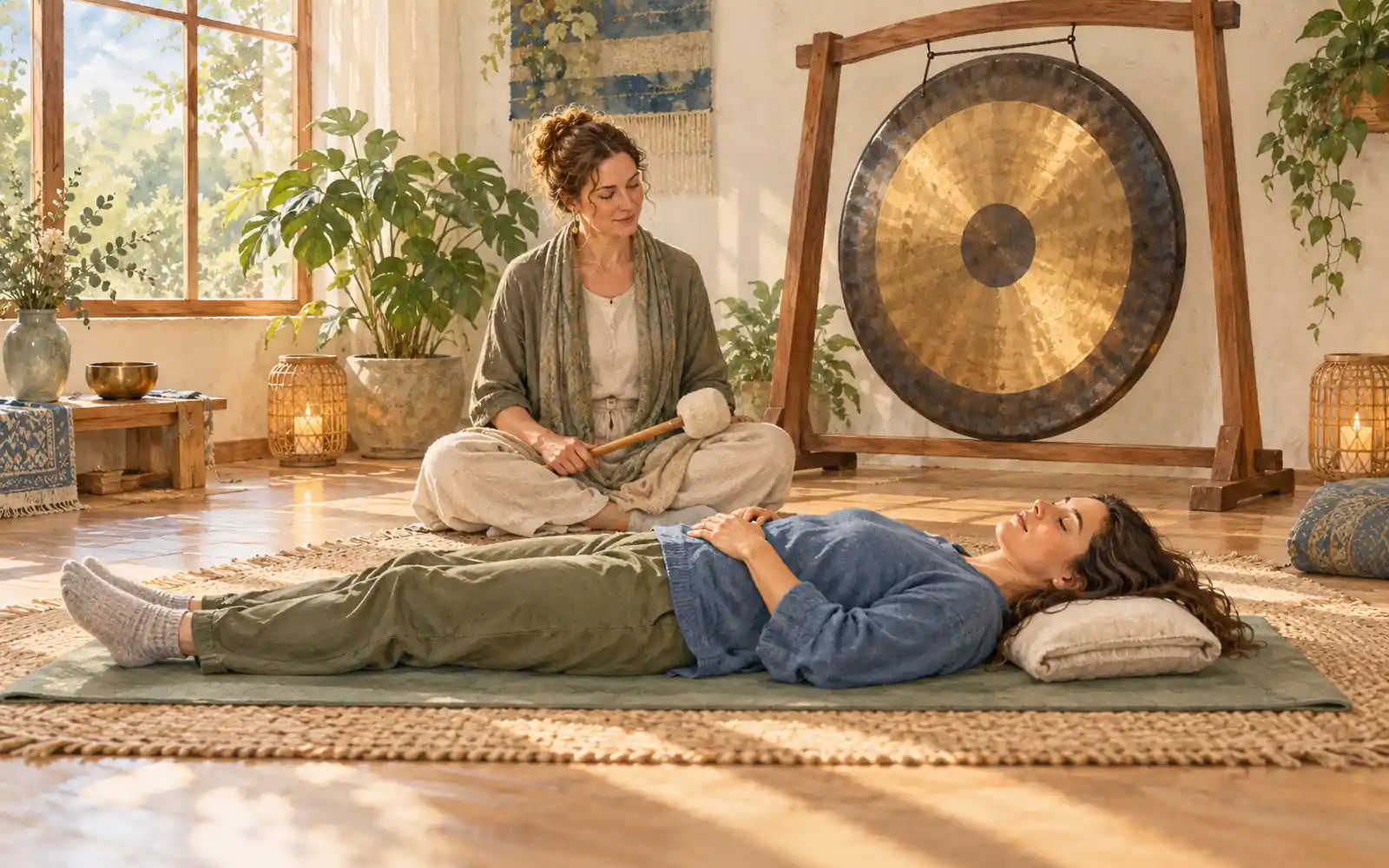
Gong meditation is a listening practice in which you sit or lie comfortably while a facilitator plays a gong, sometimes alongside singing bowls or bells. You can use the sound as a focus for attention without needing to stop every thought. Singing-bowl research has methodological weaknesses that limit confidence in benefits, according to Cai and colleagues’ 2025 Integrative Medicine Research review.
Before booking, the useful questions are practical: What will the room sound like? Can you sit rather than lie down? Can you move away or leave if the volume feels uncomfortable? Ask for answers to these questions before you book.
What happens during gong meditation
A gong bath is a sound bath centred on a gong. There is no water involved: the word describes being surrounded by sound. A mixed sound bath may also include bowls, chimes, bells or drums.
The facilitator may begin with a brief welcome or instructions for settling into a comfortable position. During the listening period, you can notice the changing sound, allow your attention to wander and gently return to listening. You do not have to visualise anything, adopt a spiritual belief or have a particular emotional experience.
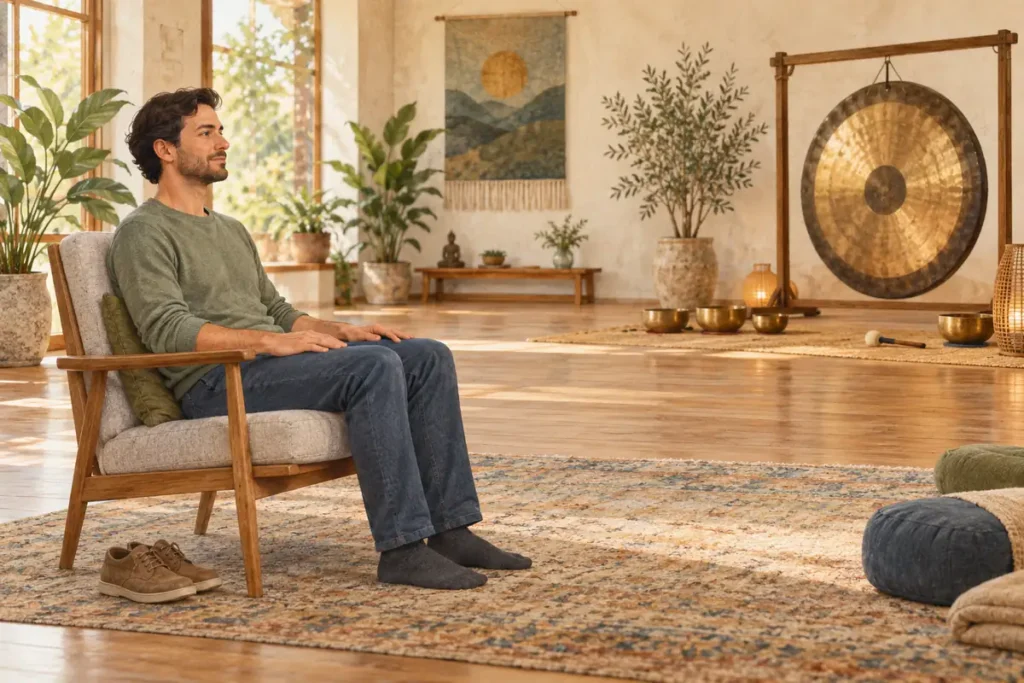
Formats differ, so ask about the session rather than assuming every class works alike. Check the advertised length, whether there are quiet intervals, how close the instruments will be and whether the facilitator uses amplified sound. Ask whether a chair is available and whether the room will be dark.
You can keep your eyes open, shift position or use a pillow. Choose a place where you can leave without stepping across other people. Agreeing to attend does not mean agreeing to endure discomfort or take part in touch-based practices.
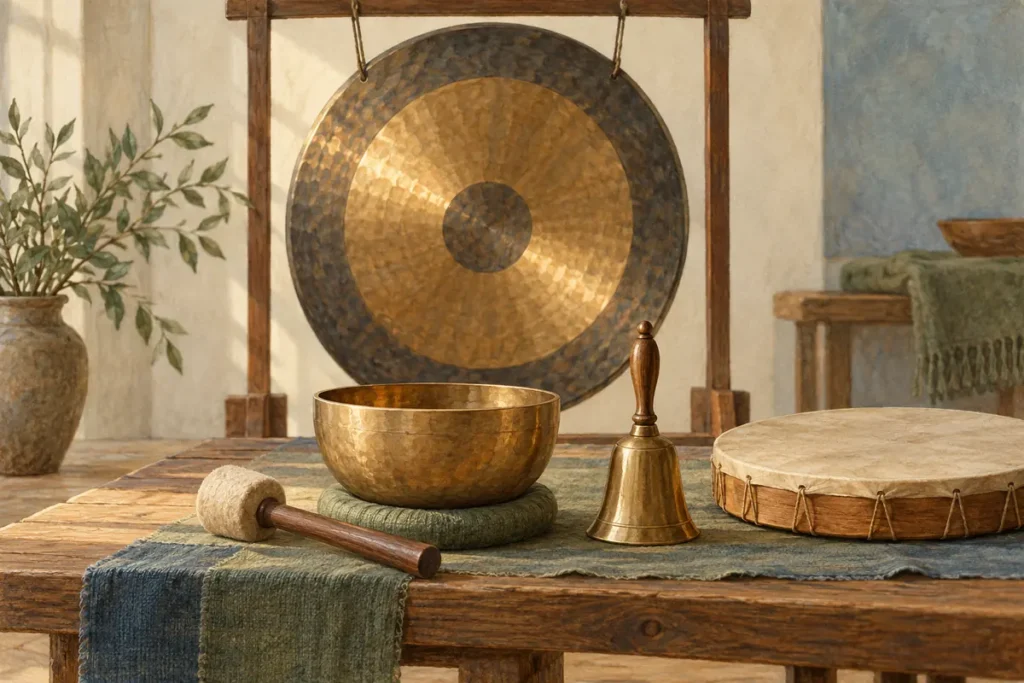
Gongs, singing bowls and other meditation instruments
The instrument helps describe the listening experience; it does not establish a medical benefit. You may prefer a simple bell with long quiet gaps, or a fuller mix of sounds. Choose the format you would be comfortable listening to.
| Instrument | How it is played | What to ask before joining |
| Gong | Struck with a mallet | How loud are the peaks and how far away can I sit? |
| Metal singing bowl | Tapped or rubbed around its rim | Are bowls kept away from participants’ bodies and heads? |
| Crystal singing bowl | Tapped or rubbed with a suitable mallet | Can I move if I find the tone uncomfortable? |
| Meditation bell or chimes | Rung or struck | Are they used as occasional cues or throughout the session? |
| Meditation drum | Played rhythmically | Will there be sustained drumming or sudden changes? |
The label “Tibetan singing bowl meditation” tells you little about a particular class’s volume, teaching or cultural context. Ask what the practitioner means by the label and what they actually do. Avoid assuming that an instrument’s name verifies claims about its age, origin or healing power.
What research says about singing bowl benefits
What the Goldsby study measured
Goldsby, Goldsby, McWalters and Mills’ 2017 Journal of Evidence-Based Complementary & Alternative Medicine study included 62 adults. Participants reported less tension, anger, fatigue and depressed mood after a roughly hour-long sound meditation. The session used several instruments, predominantly singing bowls, and also included gongs.
The Goldsby and colleagues 2017 Journal of Evidence-Based Complementary & Alternative Medicine study compared questionnaires before and after the session without a control group. It could not separate the contribution of the instruments from resting, expectations or the setting. It also did not establish lasting effects or show that a gong alone treats a mental health condition. The paper appeared online in 2016 and in a 2017 journal issue.
What later studies add
Cai and colleagues’ 2025 Integrative Medicine Research systematic review identified 19 clinical studies of singing bowls. Some findings favoured anxiety or sleep outcomes, but results and interventions varied. The authors identified high risk of bias in the randomized trials, and substantial differences limited pooling. These findings do not establish the effects of an ordinary gong class.
Ravikumar and Sathyanarayanan’s 2026 Cureus randomized trial reported lower anxiety scores after a structured sound-based meditation programme than after its remote music comparison, after adjusting for baseline scores. However, the programme combined meditation, recordings and several instruments. The programme was delivered in person and the comparison remotely. That difference, together with the combined intervention, prevents attributing the result specifically to gongs or one frequency.
For a personal decision, ask what you want from the session. If it is a comfortable break that fits your budget, you can judge that experience directly. If it is treatment for persistent anxiety, depression or insomnia, discuss care with a qualified clinician rather than relying on a class’s promotional claims.
Sound healing beliefs and what they can tell you
“Sound healing meditation” is a broad label. A practitioner may use it for ordinary relaxation, or within a spiritual framework involving chakras, energy or particular frequencies. Ask which meaning they intend before paying for a session.
In Cai and colleagues’ 2025 Integrative Medicine Research review, chakra and organ correspondences appear as traditional explanatory frameworks. They are not demonstrated by the clinical findings. Those explanations remain beliefs.
You can treat spiritual imagery as an optional way to reflect if it fits your beliefs. You can also listen without it. If a facilitator interprets a sensation or emotion for you, you do not have to accept that interpretation.
Ask for evidence when advertising promises a cure, guaranteed emotional release or a measurable bodily change. The Ravikumar and Sathyanarayanan 2026 Cureus trial, for example, used a combined programme; its results cannot verify a special healing property of its recorded frequency. Enjoying a session does not show that its advertised healing explanation is correct.
Dangers of singing bowls and loud sound baths
Sound level matters more than the wellness label
The US National Institute on Deafness and Other Communication Disorders’ Noise-Induced Hearing Loss guidance, updated in 2025 and accessed in October 2026, explains that sound can damage hearing when it is too loud, too close or lasts too long. Louder sound requires less exposure time to cause harm. Those principles apply regardless of whether the source is described as music, meditation or healing.
Ask how the facilitator manages loud peaks and monitors sound levels. Choose a position away from instruments and keep a clear route out. Do not interpret pain or a request to lower the volume as a failure to relax.
The NIDCD guidance recommends reducing exposure, moving away or using appropriate hearing protection when sound is hazardous. It also advises having your hearing tested if you suspect hearing loss. Stop listening if the sound is uncomfortable; seek assessment if symptoms persist or you are concerned about a change in hearing.
Adapt the practice to your circumstances
If you already know that particular sounds are difficult for you, discuss that before booking. Ask whether you can hear a brief sample, attend a quieter session or sit farther away. A recording with volume under your control may be a more manageable first experiment.
If you have a health condition or an individual restriction that could affect participation, ask your own clinician about the specific setup. Do not rely on an internet list that declares every sound bath universally safe or forbidden. Listening at a distance and having a vibrating instrument placed on the body are different procedures; the latter needs separate discussion and consent.
How to prepare for your first sound bath
The following steps are practical preparation suggestions, not a clinically tested treatment protocol.
- Choose a clear aim. You might want to listen quietly or see whether you enjoy the setting. Avoid setting a requirement to feel deeply relaxed, fall asleep or have an emotional breakthrough.
- Check the setup. Ask about duration, instruments, amplification, sound-level management and seating. Request a chair, extra space or an accessible exit if you need one; establish whether the venue can provide it.
- Bring what makes the position workable. Follow the venue’s instructions about mats or blankets. Wear comfortable clothing and choose a position you can change, rather than one you feel obliged to hold.
- Decide how you will respond to discomfort. Locate the exit and ask how to signal the facilitator. You can open your eyes, move away, sit up or leave; you do not need to wait for permission to stop listening.
- Review the experience afterwards. Notice whether the volume, position and teaching suited you. Consider the cost and convenience before deciding whether another session is worth booking.
A useful question to send beforehand is: “I’m new to sound baths. Can you explain the loudest parts, where I can sit away from the instruments, and whether I can leave quietly?” You can adapt this message to your needs.
Check the cancellation policy too. If the facilitator cannot explain the format or dismisses questions about comfort, choose another session or try a different kind of meditation. You are evaluating a service, and clear information should be available before you commit.
Try a short sound meditation at home
You do not need to buy a gong or a singing bowl to try focused listening. A simple recording or an occasional bell can give you something to notice. This original exercise is a way to explore your preferences; it has not been tested as a treatment.
- Sit in a comfortable position and choose a short recording with predictable sounds. Keep the volume low and the playback controls within reach.
- Listen for the beginning of a sound and how it changes. You do not need to count tones or assign them meanings.
- When attention drifts, return to a sound you can hear now. Leave your breathing natural rather than trying to match the recording.
- Pause or stop if you dislike the sound or feel uncomfortable. You can finish in silence.
- At the end, notice whether you want the same setup again, a different recording or no sound at all.
Start with a few minutes if that feels manageable. The duration is your choice, not a research-based minimum or an amount required for healing. Avoid turning a small listening experiment into another task you must perform correctly.

Using a sound bath for sleep
If you want sound as part of a bedtime routine, choose playback you can control rather than leaving an unfamiliar session running. Preview the recording for abrupt changes, advertisements or a loud ending. Set it up before settling down, so you do not have to keep checking the screen.
For more ideas about selecting audio, see LifeNByte’s guide to meditation music for sleep. Treat sound as optional: you can choose silence if listening keeps your attention busy.
Cai and colleagues’ 2025 Integrative Medicine Research review reported mixed sleep findings across differing interventions. It does not establish that a commercial gong bath or bedtime recording treats insomnia. If sleep difficulties persist or affect daily life, seek an assessment rather than buying progressively more elaborate audio programmes.
Common questions about gong meditation
A gong bath is a sound bath in which a gong is central to the session. Other sound baths may use several instruments or focus on bowls. Ask about the actual format because the name alone does not describe volume or teaching style.
You can try the listening exercise without learning a complex sequence. Ask whether the advertised class welcomes beginners and explains how to participate. You can keep your eyes open and choose a comfortable position.
Ask the venue to confirm that a chair is available before booking. Choose a supported position that you can adjust without discomfort. There is no need to copy the posture of people around you.
You do not need to produce a particular feeling to complete the session. Review whether you liked the sounds, volume and setting before deciding to return. You can choose another practice without treating your response as a personal failure.
Yes, you can use an occasional bell as a listening cue. Allow the sound to finish and spend some time in silence before ringing it again. Choose a comfortable volume and stop if it bothers you.
You can explore focused listening with a recording before buying an instrument. If you decide to buy one, consider its sound, handling and return policy. A price or a healing label does not establish suitability for you.
Move away, ask for a lower volume or leave the listening area. The NIDCD’s Noise-Induced Hearing Loss guidance, updated in 2025 and accessed in October 2026, recommends reducing noise exposure or protecting your hearing when needed. You do not have to tolerate discomfort to participate.
You can listen with the aim of noticing sound and taking a quiet break. Ask whether spiritual instructions are optional before joining a class. You do not have to adopt an explanation that does not fit your beliefs.
Choose a listening practice that suits you
Before your first session, check the sound level, seating and freedom to leave. Begin with a format you can adjust, and use your experience to decide whether to return. If you liked the sounds and the session was comfortable, that can be enough reason to return. If it was not, try a quieter recording, a different practice or silence.