

Beginners quit meditation because the experience contradicts what they were promised. They sit down expecting calm and meet a loud, restless mind. They expect a payoff inside a week and get nothing they can measure. The numbers are blunt: in a 2026 survey of 536 app users published in the Journal of Medical Internet Research, roughly 90% dropped off within the first week, and fewer than 20% were still practising after day 7. Quitting isn’t the exception in meditation. It is the default outcome.
What separates the people who stay isn’t willpower or talent. In that same survey, the strongest predictors of continued use were readiness to change and realistic expectations — and, notably, none of the eight mental-health measures tested predicted engagement at all. Below are the eight reasons beginners drop out, the statistics behind each one, and the fix that follows from it.
For the 22-year-old startup intern, the 29-year-old architect juggling deadlines, or the 34-year-old feeling like their brain’s a tab overload.
So… you tried meditating. And hated it.
Maybe you downloaded Headspace. Or watched a monk on YouTube. You lit a candle. Crossed your legs. Took a deep breath.
And five minutes later, you were thinking about leftover pizza, an unread Slack message, and whether your boss secretly hates you.
Welcome to the club.
You’re not lazy. You’re not broken. You’re not “bad” at meditation.
But yeah—most people quit in the first week. And not because they don’t want peace of mind, but because the experience feels nothing like the promise.
Let’s break down why this happens, and more importantly—how to actually stick with it.
Why People Quit Meditation: The Statistics
This isn’t just a feeling. It’s the norm, and it has been measured. The most current figures come from Adams and colleagues’ 2026 cross-sectional survey of 536 meditation app users across the US, UK, Australia, Canada and New Zealand.
Why it Works (or doesn’t): That survey, published in the Journal of Medical Internet Research, found that roughly 90% of meditation app users drop off within the first week of real-world use, and randomized controlled trials of mindfulness apps show an average 42% drop in participation over just 1–2 months. Even among people who stick around, typical use was around 3 sessions a month — a session every 9 days, not the daily habit most people picture.
| What was measured | The number |
|---|---|
| Users who drop off within the first week | ~90% |
| Users still practising after day 7 | Fewer than 20% |
| Real-world disengagement within two weeks | As high as 94% |
| Average drop in participation in 1–2 month app trials | 42% |
| Median use among people who stay | 3 sessions / ~40 minutes a month |
| Users doing more than 11 sessions a month | 25% |
| Users practising at a clinically meaningful dose | Top 5% |
Read the fifth row again, because it is the one nobody quotes. Among people who did not quit, typical practice was three sessions a month — roughly one every nine days, about forty minutes in total. The daily-sitting ideal that most meditation content is built around describes the top 5% of users, not the average one. If you are measuring yourself against that ideal, you are measuring yourself against a statistical outlier.
Worth being clear about what these numbers cover: app-based practice, which is how most beginners now start. The abandonment pattern isn’t unique to meditation either — it runs across the whole wellness-app category, which we look at in our guide to self-improvement apps.
So if you lasted five minutes before your brain wandered off to leftover pizza and a Slack message — you didn’t fail some test everyone else is passing. You ran into the same wall almost everyone runs into. The difference isn’t willpower. It’s whether you understand why it happens, which is what the rest of this is actually about.
1. The Illusion of Immediate Calm
You hear the word “meditation,” and what pops up?
Someone glowing with peace. Serene expression. Zero thoughts. Bliss mode.
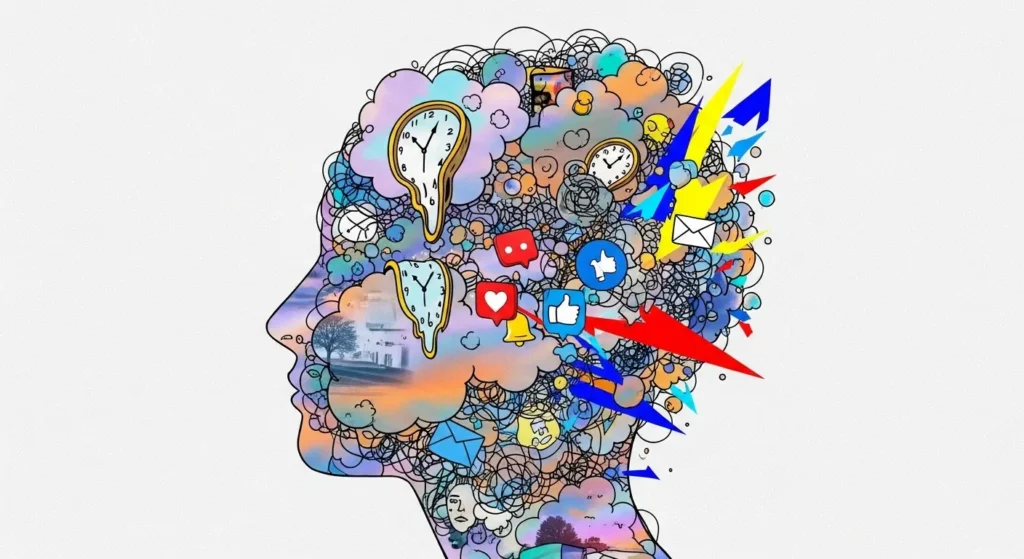
What you get instead is a traffic jam of thoughts. Loud, chaotic, endless. And that mismatch? It wrecks your expectations.
You sit down thinking you’ll float, but instead, you’re drowning in thoughts about deadlines, your ex, that weird thing you said at a party in 2018.
Here’s the thing:
Meditation isn’t about clearing your mind.
It’s about watching it do its messy little dance, without judging yourself for it.
If that feels awkward, that’s good. You’re actually doing it right.
The JMIR survey backs this up from the other direction: people who expected the app to help with sleep, stress, anxiety, happiness or focus were more likely to keep using it, and the authors note that mismatched expectations work against you. Expecting a quiet mind is the mismatch. Expecting to notice a busy one is not. If the noise itself is the problem, that has its own set of fixes — see our guide to quieting an overthinking mind.
2. Your Brain Hates Doing Nothing
Let’s be honest—most of us can’t even stand in line without unlocking our phones.
Stillness feels unnatural. Almost threatening. And your brain will fight it. Hard.
Why? Because it’s used to stimulation. Notifications. Dopamine hits. The kind you get from scrolling, swiping, consuming.
Meditation? That’s a dopamine drought.
So when you sit quietly, your brain screams:
“This is boring. You’re wasting time. Do something.”
But boredom isn’t failure. It’s just withdrawal from overstimulation.
The trick? Don’t push it. Start with two minutes. Literally. Two. Let it feel stupid. Let it feel awkward.
But stick with it.
A Beginner’s Guide to Meditation (Without Feeling Like a Pretzel or a Failure).
3. You Expect Results Too Soon
We’re wired for short-term rewards. Get a like, feel good. Complete a task, get the dopamine.
But meditation? It’s weirdly slow. The benefits sneak in sideways. You don’t feel “productive,” even though your brain’s literally rewiring itself.
So after a few days, you wonder: What’s the point?
I’m still anxious. Still overthinking. Still snapping at my roommate.
But here’s a better question:
What if the point isn’t instant peace… but gradual resilience?
You don’t lift weights for a week and expect a six-pack. Same goes here. The gains are subtle. But they stack. That compounding logic lines up with the research on why self-directed change works: real behavior change tends to build gradually through repetition, not one big push.
Sleep starts to feel deeper. Your fuse gets a bit longer. That constant mental noise? A little less shouty.
The Power of Morning Meditation: A Step-by-Step Guide.
4. You Think You’re “Bad” at It
This one’s huge.
People quit because they think:
“I can’t stop thinking. I must suck at this.”
But nobody “stops thinking.” Not even monks. The mind thinks—that’s its job.
Your job is to notice when it wanders, and gently bring it back. Over and over and over.
It’s like training a puppy. You don’t yell at it for running off. You just guide it back, patiently. Again.
That’s the whole game.

5. You’re Making It Too Serious
Somewhere along the way, meditation got wrapped in pressure.
Sit a certain way. Breathe a certain way. Don’t move. Don’t scratch. Don’t think.
But that rigidity? It kills the vibe.
Try this:
- Meditate lying down
- Or while walking
- Or with music
- Or on your lunch break, in your car, with one AirPod in
Seriously—if you can scroll TikTok while half-listening to a podcast, you can absolutely meditate while the laundry spins.
It doesn’t have to be sacred. It just has to be honest.
10 Health Benefits of Meditation and How to Focus on Mindfulness.
6. You’re Not Seeing Micro-Wins
Let’s say you meditated for 4 days last week. Then skipped 3. Most people would beat themselves up and quit.
But hold up—4 days is massive.
You paused. You noticed. You showed up for yourself. That’s not failure. That’s progress.
Track the micro-wins:
- Did you show up today?
- Did you notice your breath for 5 seconds?
- Did you catch your overthinking before it spiraled?
Those are reps. Invisible, but real.
Think of it like brushing your teeth. You don’t skip a day and say “Well, I guess I’m done forever.”
Same deal here.
7. You’re Meditating Alone (And It’s Kinda Lonely)
Trying to start a habit solo—especially one that messes with your internal wiring—is tough.
So if you can, loop someone in.
Join a friend on a 7-day streak. Share screenshots of your Calm or Insight Timer stats. Follow a creator who talks about their practice in real-time. Maybe even start a tiny group on WhatsApp.
Does it sound silly? Sure. But humans aren’t built for solo missions. Even something as internal as meditation can feel lighter with a little social nudge.
8. It Genuinely Felt Bad (And That’s Documented)
This is the reason almost no beginner guide will tell you, so here it is plainly: for a meaningful minority of people, meditation is not pleasant, and that is a documented phenomenon rather than a personal defect.
In a 2019 study of 1,232 regular meditators published in PLOS One, 25.6% reported having had a particularly unpleasant meditation-related experience. A separate 2021 international survey of 1,370 meditators in BJPsych Open put the figure at 22% — close enough to the first to take both seriously.
Note who those studies sampled: regular meditators, people who had stuck with it for at least two months. If a quarter of the people who kept going still ran into something genuinely unpleasant, the beginners who quit after two bad sessions were not being fragile. The PLOS One authors found the risk was higher for people who had attended retreats, who practised only deconstructive styles such as Vipassana or koan work, and who scored high on repetitive negative thinking.
The practical upshot is not “don’t meditate.” It is that the style matters more than beginners are told. If sitting in silence with your own thoughts reliably makes you feel worse, switching to a guided, body-focused or movement-based practice is a legitimate response, not a downgrade. And if a practice consistently produces real distress, stopping and talking to a professional is the correct call — a point we make in our guide to self-directed change and where it stops being enough.
What Actually Predicts Whether You Stick With It
The same JMIR survey that produced the drop-off numbers also tested what separates the people who continue from the people who don’t. The results are worth knowing before you blame yourself for quitting.
The most robust predictor was readiness to change — whether someone was actually at the point of wanting to change a behaviour, rather than merely liking the idea (correlations of ρ=0.24–0.33 across measures). Realistic expectations of what the app would do came next, followed by education level and openness to new experience. How much someone liked the app itself mattered too: perceived quality correlated with use at r=0.28–0.51.
Now the finding that should change how you read every other article on this topic: none of the eight mental-health measures tested predicted engagement. Not depression, not stress, not psychological distress. The people most likely to be told “you should meditate” were no more and no less likely to keep meditating. The authors suggest the symptoms people are trying to treat may be the same ones that make the practice hard to sustain.
Translated into something usable: if you quit, the useful question is not “what’s wrong with me?” It is “was I actually ready to change this, and was I expecting the right thing?” Those two are addressable. Your anxiety level, as a predictor, apparently isn’t.
Real Talk: How to Actually Stick With It
Alright, let’s boil this down. Here’s how to keep your practice going without burning out:
1. Start embarrassingly small.
Two minutes a day. Seriously. Build the habit first, scale later.
2. Ditch the fantasy.
You’re not chasing monk mode. You’re learning to sit with your thoughts, not erase them.
3. Switch it up.
Try guided, silent, walking, or even ambient sound meditation. Test what feels less annoying.
4. Track, don’t obsess.
Use a habit tracker or app streaks just to stay aware. Don’t use it to punish yourself.
5. Let it be messy.
Some sessions will suck. You’ll fidget. You’ll forget. That’s fine. Keep going.
6. Aim at three sessions a month before you aim at thirty.
That is what the people who didn’t quit actually do. Set the target where the data is, not where the marketing is, and beat it if you feel like it.
None of this is meditation-specific, incidentally. It’s the same set of mechanics that make any behaviour stick, which we break down in our guide to building habits that last — including why the “21 days to a habit” line is a myth and what the real median looks like.
Frequently Asked Questions
A 2026 survey of 536 app users in the Journal of Medical Internet Research found roughly 90% of meditation app users drop off within the first week of real-world use, and controlled trials show around 42% drop in participation over just 1-2 months. If you quit early, you’re the norm, not the exception.
Start with two minutes. That’s not a typo — building the habit of showing up consistently matters far more at first than session length. Scale up gradually once two minutes feels easy, rather than starting with 20-30 minutes and burning out in week one.
Yes. Meditation isn’t a fast-acting fix for anxiety — the benefits tend to be gradual and subtle (better sleep, a slightly longer fuse, quieter mental noise) rather than a dramatic before-and-after. If you’re still anxious after a few weeks but noticing small shifts, that’s the practice actually working, not failing.
The 2026 JMIR survey of 536 app users found roughly 90% drop off in the first week, fewer than 20% still practising after day 7, and real-world disengagement as high as 94% within two weeks. Randomised trials of meditation apps lose an average of 42% of participants over 1–2 months. Among the people who stay, median use is about 3 sessions and 40 minutes a month — the daily practice most articles assume describes only the top 5% of users.
Median use among people who keep going is roughly 3 sessions a month, about one every nine days, totalling around 40 minutes. A quarter of users manage more than 11 sessions a month. Daily practice is not the norm even among people who have not quit, so treating three sessions a month as a floor rather than a failure is a more realistic starting target.
No. Meditation is not classified as an addictive behaviour and there is no recognised clinical diagnosis for it. What research does document is the opposite problem — most people practise far less than they intend, with median use around three sessions a month. Separately, a minority of regular meditators report unpleasant or distressing experiences, particularly after intensive retreats, so the risk that has actually been measured is adverse experience rather than dependence.
There is much less research on stopping than on starting, so be sceptical of confident claims either way. The general pattern in mindfulness research is that benefits track ongoing practice rather than persisting indefinitely after it ends, so effects tend to fade gradually rather than reverse sharply. Nothing in the literature suggests a withdrawal effect. Practically, stopping for a stretch and restarting later is normal — given that roughly 90% of app users stop within a week, most meditators are restarting rather than continuing.
Calm is not the measure. The 2026 JMIR survey found that expectations predict whether people keep going, and mismatched expectations work against them — so defining success as a quiet mind sets up the exact mismatch that causes quitting. The practice is the noticing and returning, which you are doing every time your attention wanders and you bring it back. If after several weeks nothing at all has shifted, that is worth taking seriously, but a busy mind during a session is not evidence of failure.
No, and this is more common than beginner guides admit. A 2019 PLOS One study of 1,232 regular meditators found 25.6% had experienced a particularly unpleasant meditation-related experience, and a 2021 BJPsych Open survey of 1,370 meditators put it at 22%. Risk was higher for people who had attended retreats, practised only deconstructive styles such as Vipassana, or scored high on repetitive negative thinking. Switching to a guided, body-focused or movement-based practice is a reasonable response. If a practice reliably causes real distress, stop and speak to a professional.
Final Thought
Meditation isn’t a “fix.” It’s a practice—and that word matters.
You practice showing up. You practice noticing. You practice breathing, even when your mind throws a tantrum.
And with enough reps, something shifts. Not all at once. Not dramatically. But slowly, quietly, in the background of your day-to-day.
You pause before reacting.
You notice tension before it explodes.
You sit with discomfort, instead of running from it.
And maybe—just maybe—that’s the kind of peace that actually sticks.
Want help getting started?
Try Insight Timer, Balance, or Waking Up.
Or just set a 2-minute timer. (On why the number on the timer matters less than the number of days, see how long you should meditate.) (On why the number on the timer matters less than the number of days, see how long you should meditate.) Sit. Breathe. Repeat.
You’ve got time. You really do.












4 thoughts on “Why Do Beginners Quit Meditation? 8 Reasons + the Statistics”