The fastest way to clear your mind is to name the thought rather than fight it. Putting a feeling into words measurably reduces the brain’s emotional response to it, while trying to push a thought away reliably makes it come back stronger. That single distinction separates the techniques below that hold up under testing from the one that most articles still recommend anyway.
It is 2:47 AM and you are replaying a conversation from nine hours ago, wondering if you said the wrong thing. Overthinking is your brain’s misguided attempt to solve a problem by analysing it endlessly. It feels productive. It is not.
These 14 techniques are ordered from fastest to deepest, and each one says plainly what the research does and does not show. Two of them come with a warning label: technique 3 is the method most “stop overthinking” lists open with, and the evidence says it backfires. Technique 4 is the one everybody prescribes for sleep, and the best-controlled trial to date found it does not improve sleep at all. You will not find either caveat on the pages currently outranking this one.
How to Clear Your Mind Instantly (When You Have 60 Seconds)
If you need your head clear right now and have no time for a practice, do this in order. It takes about a minute and works standing in a corridor, sitting in a car, or lying in the dark.
- Name the thought out loud or in your head, in the third person: “I’m having the thought that I handled that badly.” Not “I handled that badly.” The extra words are the active ingredient.
- Breathe out longer than you breathe in. Two short inhales through the nose, then a long, slow exhale through the mouth. Repeat five times.
- Move your eyes off the middle distance. Look at one object and describe it to yourself in detail for ten seconds — colour, texture, edges.
- Write the thought down, or say it to someone. If neither is possible, decide the single next physical action you will take and start it within thirty seconds.
Why this order: step 1 does the heavy lifting. In an fMRI study at UCLA, labelling an emotion reduced activity in the amygdala and increased it in the right ventrolateral prefrontal cortex — the region associated with deliberate control — compared with other ways of processing the same images. Naming a thought is not a euphemism for ignoring it. It is a different neural operation from having it.
Step 2 has its own evidence, and a surprise attached, which is covered in technique 11. Steps 3 and 4 are there because clearing your mind “instantly” is realistically about interrupting a loop for long enough to do something else — not about emptying your head. Nobody empties their head. The goal is to stop the same sentence from running for the eleventh time.
How to Tell If You Are Overthinking (and When It Is Just Thinking)
Thinking hard about a problem is not overthinking. The clinical term for the unproductive version is rumination, and the distinguishing feature is not how long you think or how intensely — it is whether the thinking moves.
You are probably overthinking rather than thinking if:
- You have been over the same situation for ten minutes or more without producing a new fact, a new option, or a decision.
- The questions are about why (“why am I like this”, “why did they say that”) rather than what next.
- You keep reaching the same conclusion and then re-checking it.
- You feel worse at the end of the thinking than you did at the start.
- You are rehearsing a conversation that has already happened, or one that may never happen.
- You notice it most in the gaps — the commute, the shower, the twenty minutes after the lights go out.
The distinction matters because the two are treated differently. A review of two decades of research on response styles theory found that rumination does not just accompany low mood — it deepens negative thinking, impairs problem-solving, interferes with taking action, and erodes social support. The same review found it is linked to anxiety, binge eating, binge drinking and self-harm, not to depression alone. In other words: the loop is not a harmless quirk that resolves once you find the answer. The looping is itself the thing to interrupt.
Reflection — deliberately examining an experience to learn from it — looks similar from the outside and behaves differently. If you cannot tell which one you are doing, the ten-minute rule above is the most reliable test available without a clinician.
Why Do You Overthink Everything?
You overthink because the mind treats it as a habit, not because something is wrong with you. The most useful research-backed answer is not a personality flaw or a chemical you are short of — it is that rumination is a learned response, reached for automatically the way any well-worn habit is, and kept running by a handful of ordinary mechanisms rather than one deep cause.
The clearest model of this comes from a 2020 review that set out to explain what actually keeps the loop going. Its authors propose that rumination develops into a mental habit built from dwelling on unresolved goals, a tendency to process events in an abstract “why is this happening to me” way rather than concretely, and reduced executive control that makes the habit hard to interrupt once it starts. The practical implication is the hopeful part: a habit is trained, and a trained response can be retrained — which is exactly what the techniques further down this page are doing.
It also explains the three things people notice about their own overthinking:
- It fires without permission. That is the habit component — a familiar cue (a quiet moment, an unresolved conversation) triggers the response before you decide to engage it.
- It circles instead of concluding. Abstract “why” processing has no natural end point, where a concrete “what is the next step” question does. This is why reframing the question works.
- It gets worse when you are depleted. Executive control drops when you are tired, stressed or overloaded, which is why the loop is loudest late at night and after a hard day.
There is a fourth trigger worth naming: overthinking is often a response style — a habitual way of reacting to low mood. The two-decade review of response styles theory found that a low mood reliably sets the loop going, and the ruminating then deepens and prolongs the mood, which feeds the next lap. If it feels like the overthinking and the bad feeling cause each other, that is because, mechanically, they do. None of this means you are stuck with it. It means the lever is the habit and the trigger, not your character — and that is a lever you can actually pull.
14 Quick Techniques to Stop Overthinking
1. Recognize Your Thought Loops
The technique: Set phone reminders three times daily asking: “What am I thinking about right now?” If you have been mentally rehashing the same situation for ten minutes or more without taking action, you are overthinking.
Why it works: You cannot interrupt a loop you have not noticed, and loops are most often noticed by accident, late. A scheduled prompt converts noticing from luck into a routine.
Quick tip: Label the thought rather than restate it: “I’m having that worried thought about tomorrow’s meeting again.” This is the same affect-labelling move described above, and it is the highest-value habit on this page.
2. Focus on What You Can Control
The technique: When overthinking strikes, ask: “Is this something I can actually influence?” Redirect mental energy only to controllable factors.
Make it practical: Create two columns, “Can Control” and “Cannot Control,” and sort the worry into them. The point is not the categorising — it is that the “Can Control” column must produce a next action before you close the notebook.
An honest note on the evidence: this is a widely taught cognitive-behavioural exercise, but we could not find a trial isolating the two-column sort itself. What is well evidenced is the underlying problem it targets: rumination measurably impairs problem-solving and interferes with instrumental behaviour. Forcing the exercise to end in an action is what makes it more than sorting.
3. Notice the Thought Instead of Blocking It (Why “STOP” Backfires)
This entry used to say something different. The earlier version of this article told you to say “STOP” and push the thought away. That advice is common, it is intuitive, and the research says it does the opposite of what it promises.
What the evidence shows: In the original white-bear experiments, participants asked not to think of a white bear could not suppress the thought, and then thought about the bear significantly more afterwards than people who were told to think about it from the start. The authors’ conclusion was blunt: attempted thought suppression can produce the very preoccupation it is aimed at. Two decades of follow-up work, summarised in an Annual Review of Psychology paper on thought suppression, found the rebound effect holds up and is worse under stress and cognitive load — which is precisely when you reach for it.
Do this instead: Notice, name, and let it stand. “There’s the meeting thought again.” Then redirect attention to something specific and absorbing rather than to nothing. The same white-bear study found that people given a concrete alternative to think about were less likely to show the later rebound — distraction with a target beats suppression without one.
Worth separating: the mindfulness acronym STOP — Stop, Take a breath, Observe, Proceed — is a different thing that happens to share a name. Its third step is observing the thought, not deleting it. That version is fine.
4. Create a Daily “Worry Window”
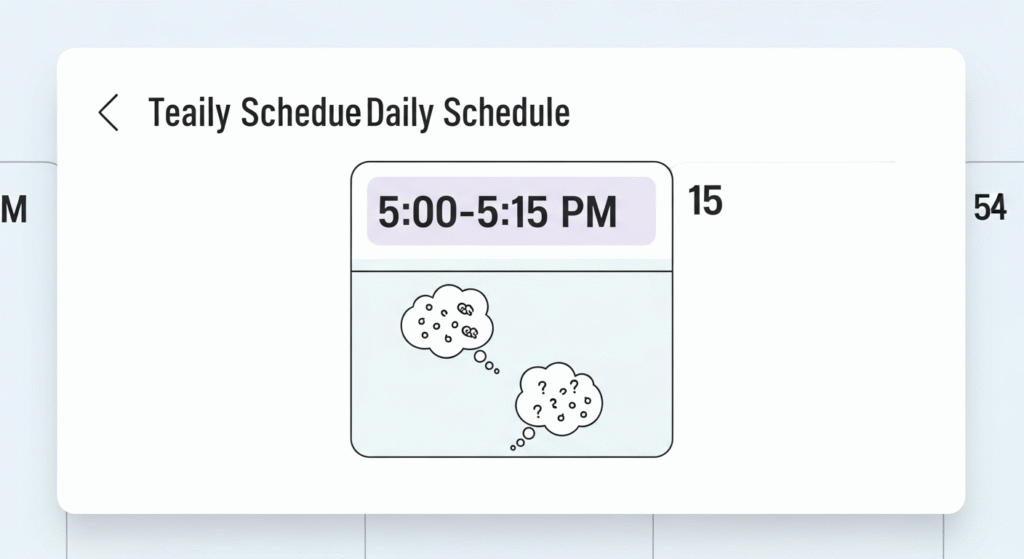
The technique: Schedule a fixed 30-minute period, at the same time and in the same place each day, for intentional worrying. When a concern arrives outside that window, note it and say: “I’ll take this at 5 PM.”
What the evidence shows — and where it stops. This is the best-studied technique on the page, which is why it is worth reporting properly rather than with a made-up percentage:
- It works on paper, done in person. In a randomised trial of 53 high-worriers, two weeks of a time- and place-restricted 30-minute worry period beat the control condition on worry, anxiety, negative affect and insomnia symptoms — though not on depression.
- It works for the people it was designed for. A 2024 randomised waitlist-controlled trial found that two sessions of worry postponement significantly reduced worry in participants with generalised anxiety disorder, with a large pre-post effect that held at four-week follow-up. The same trial found no such benefit in a health-anxiety group.
- It does not survive being turned into an app with no support. When the identical intervention was delivered online to a general-population sample of 996, it produced no reduction in worry frequency, worry duration, or health complaints at all (partial eta squared of .000). Participants reported they simply found postponing difficult without guidance.
- It does not fix your sleep. This is the finding nobody quotes. A four-arm randomised controlled trial of 186 adults tracking worry every night and sleep every morning for 14 days found that worry postponement produced no significant improvement in sleep onset latency, number of awakenings, or sleep quality against the control conditions.
The one implementation detail that mattered: in that same 2025 trial, the arm that added a specific if-then plan — naming in advance when and where the worry period would happen and what would trigger the postponement — cut daily worry duration by roughly 15 minutes compared with plain worry postponement. Do not just decide to have a worry window. Write down the time, the place, and the sentence you will say to yourself when a worry shows up early.

5. Practice 5-4-3-2-1 Grounding
The technique: Name five things you can see, four you can touch, three you can hear, two you can smell, one you can taste.
Why it plausibly works: it is an attention task with enough structure to crowd out a verbal loop, and it requires no equipment, privacy or explanation. It is taught as a first-line coping skill by clinical services for exactly that reason.
The honest caveat: despite appearing on every anxiety listicle in existence, 5-4-3-2-1 has a much thinner direct trial record than the worry window or breathwork. It is recommended on clinical judgement and its overlap with better-studied attention-training methods, not on a body of randomised evidence for this specific script. Use it — but if it does not help you, that is not a personal failure, and you have not exhausted your options.

6. Break Loops with Movement
The technique: Take a five-minute walk, stretch, or clean something. Put attention on the physical sensation, not on the worry.
Why it works: In a study of 80 adults randomly assigned to jog or stretch for 30 minutes before a negative mood induction, the aerobic exercise attenuated the intensity and persistence of negative affect specifically in the people who reported the most difficulty regulating their emotions. The benefit was largest for the people who needed it most.
The number you have seen elsewhere, corrected: “walking boosts creativity by 60%” traces to four Stanford experiments in which walking raised divergent-thinking scores for 81% of participants, with a residual boost persisting after sitting back down. It is a real and replicated finding — about generating ideas, not about stopping a worry loop. Walk because it changes what your attention is doing; do not expect it to make you 60% less anxious.
Quick tip: Thirty seconds of shaking out your hands and arms is not a substitute, but it is better than nothing when a walk is not available.

7. Write and Release
The technique: Set a timer for ten minutes. Write everything bothering you, without editing. Then close the notebook, or tear up the page.
Why it works, and how much: expressive writing is one of the most-replicated interventions in this space and one of the most oversold. A meta-analysis of 146 randomised studies found the effect is positive and statistically significant but small — an average effect size of r = .075. That is a real benefit, and it is not a cure. Treat ten minutes of writing as reliably taking a little weight off, not as resolving the thing you are writing about.
Quick tip: This is a brain dump, not problem-solving time. If you find yourself drafting a plan, that is fine — but do it as a separate, second pass, so the offloading is not competing with the deciding.
8. Set Decision Deadlines
The technique: Give small decisions 24 hours, medium ones a week, major ones a month. When the deadline arrives, take the best option currently on the table.
Why it works: the habit this breaks has a name in the research literature — maximising, the drive to find the best possible option rather than a good enough one. Across a series of studies, people who scored higher on maximising reported less satisfaction with their choices, more regret, and lower happiness and optimism than people who settled for “good enough” — including, in one study, when the maximisers had objectively done better. Extra deliberation does not reliably buy a better outcome, and it does reliably cost you the feeling of having chosen well.
Quick tip: Ask what is actually reversible. Most decisions that feel enormous can be adjusted within a month, and knowing that in advance shortens the deliberation more than any deadline does.
9. Limit Information Overload
The technique: Try a “digital sunset” — no new inputs two to three hours before bed — unfollow accounts that reliably wind you up, and keep one news-free day a week.
What the evidence actually says: in a randomised experiment with 143 undergraduates, limiting Facebook, Instagram and Snapchat to ten minutes per platform per day for three weeks produced significant reductions in loneliness and depression compared with using them as usual. Note what that is and is not: three weeks, not one; loneliness and depressive symptoms, not rumination specifically. The commonly repeated claim that cutting social media reduces rumination by 30% within a week does not appear to come from anywhere.
Quick tip: A per-platform time limit worked in that study. “Use it less” is not a plan; ten minutes each is.
10. Replace “What If” with “Even If”
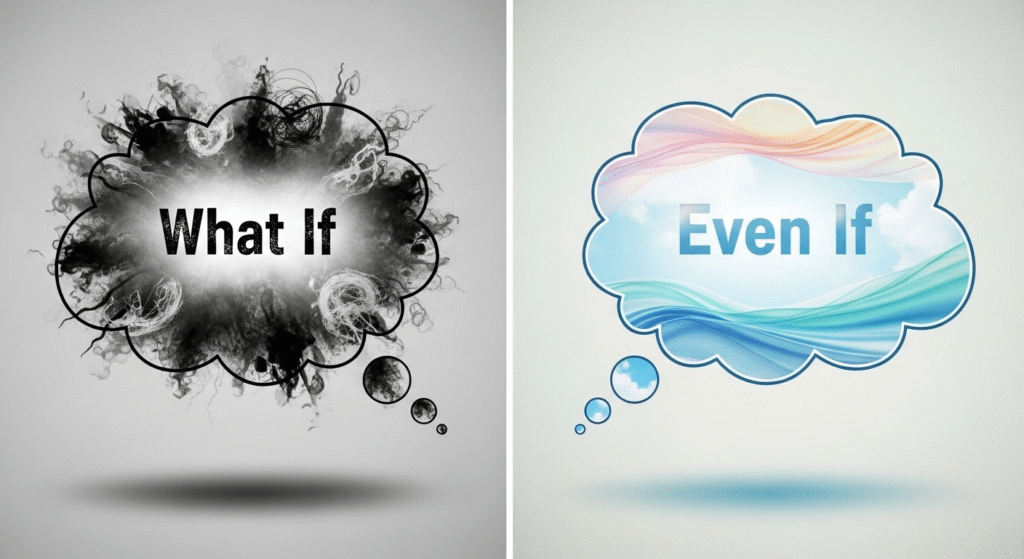
The technique: Instead of “What if I fail?” ask “Even if this doesn’t go perfectly, how will I handle it?”
Why it works: the two questions demand different answers. “What if” invites more scenarios, which is more fuel for the loop. “Even if” forces the answer to be a coping plan, which terminates in something you can actually do. This is the same move as technique 2, applied to the wording rather than to the sorting.
Quick tip: If the honest answer to “how will I handle it” is “I don’t know,” that is useful information — it means the next step is gathering one fact, not thinking harder.
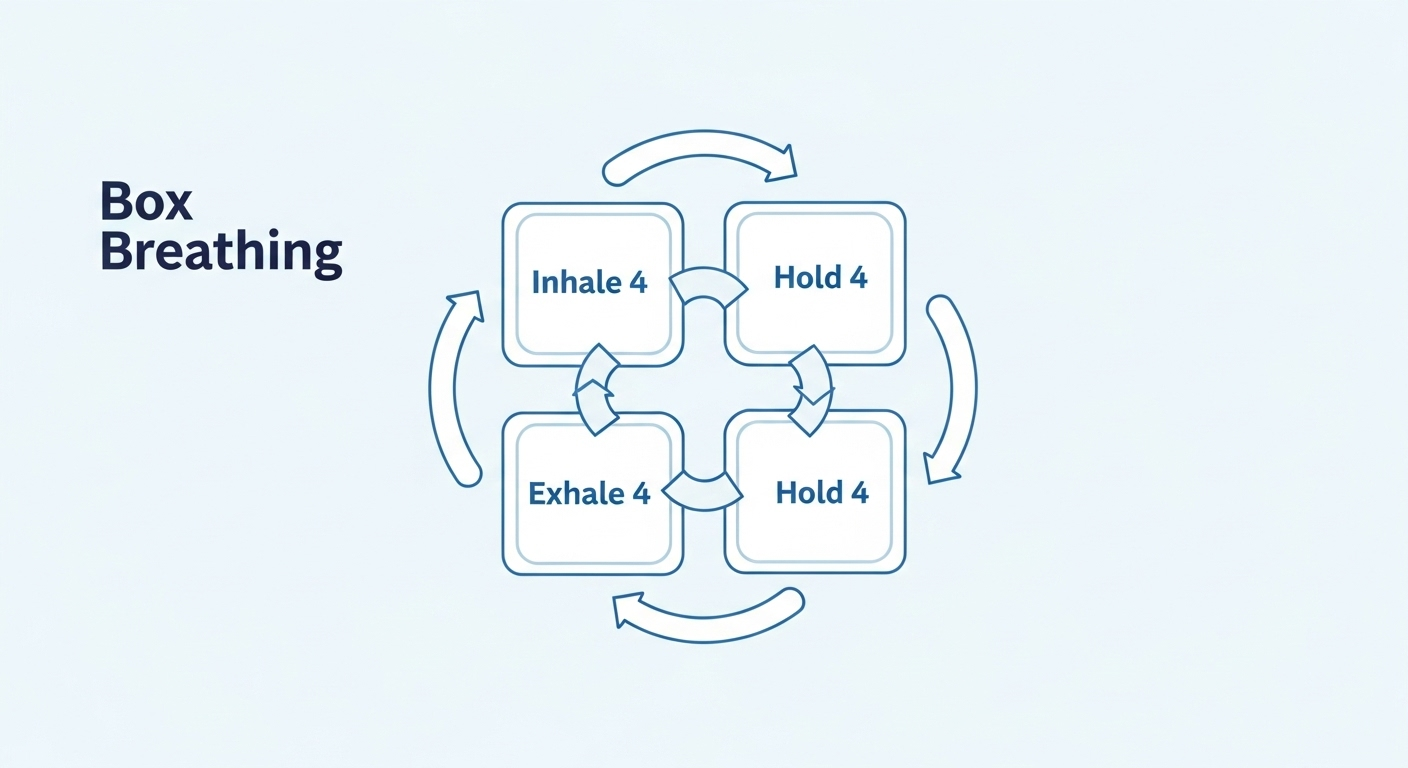
11. Try Box Breathing — but Know What Beat It
The technique: Inhale for four counts, hold for four, exhale for four, hold empty for four. Repeat four to eight cycles.
Why slow breathing works at all: a systematic review of slow-breathing studies found that breathing below ten breaths per minute consistently increases heart rate variability and respiratory sinus arrhythmia, alongside measurable changes in central nervous system activity. The mechanism is not folklore.
The part most articles leave out: box breathing has been tested head-to-head. A randomised controlled trial at Stanford compared three five-minute daily breathing practices against five minutes of mindfulness meditation over a month. Box breathing was one of the three. The winner was a different one: cyclic sighing — emphasising a prolonged exhale — produced the greatest improvement in mood and the largest reduction in respiratory rate.
What to do with that: if box breathing works for you, keep it. If it has never done much, do not conclude that breathwork is not for you — try the exhale-weighted version instead. Two short inhales through the nose, one long exhale through the mouth, five minutes. That is the pattern in step 2 of the 60-second sequence at the top of this page.
Quick tip: If four counts feels like a struggle, use three. Straining to breathe correctly is its own stressor.
12. Rebuild Self-Trust
The technique: Start making fast decisions on things that do not matter — lunch, what to wear, which route to take — deliberately and without analysis. Keep a short log of decisions that turned out fine.
Why it works: overthinking small decisions is usually a maximising habit (see technique 8) rather than a reasoning problem. Practising on stakes low enough that a bad call costs you nothing is how the habit gets loosened without a real consequence attached.
Quick tip: Review outcomes without grading yourself on them. The log exists to give you evidence, not a report card.
13. Talk It Out
The technique: Say it to a trusted person. If overthinking is affecting your sleep, work or relationships, say it to a therapist.
Why it works: a loop runs on unexamined premises, and saying it aloud is often the first time those premises get tested by anything outside your own head. It is also, mechanically, a form of affect labelling with a witness.
On therapy, accurately: a review of 269 meta-analyses of cognitive behavioural therapy concluded that the strongest support exists for CBT of anxiety disorders, somatoform disorders, bulimia, anger control problems and general stress, with CBT showing higher response rates than comparison conditions in seven of the eleven reviews that measured them. There is also a version aimed at this specific problem: in a randomised trial of 42 people with persistent depression, adding rumination-focused CBT to treatment as usual significantly improved both residual symptoms and remission rates, with the improvement mediated by the change in rumination itself. If you have tried the self-help route and the loop is unchanged, “rumination-focused CBT” is a specific and real thing to ask about by name.
Quick tip: Say what you need up front: “I don’t need solutions — I just need to process this out loud.”
14. Challenge Negative Assumptions
The technique: When the mind jumps to the worst case, ask: “What evidence supports this? What contradicts it? What would I tell a friend?”
Why it works: most overthinking runs on assumptions treated as facts. Writing the worry down and listing three alternative explanations that are equally or more likely turns an unfalsifiable feeling into a claim that can be checked.
Quick tip: Do this on paper, not in your head. Done mentally, it becomes another lap of the loop.
If the loop is loudest at bedtime specifically, our guide to sleep meditation covers the wind-down versions of several of these, and 10 quick stress-relief techniques ranked by evidence takes the same sceptical approach to the physical side. If sitting still to meditate is where you keep stalling, why beginners quit meditation and how long you should actually meditate are the two most useful next reads. And when the loop is really harsh self-talk, self-love meditation scripts to quiet your inner critic target that voice directly.
Frequently Asked Questions
Name the thought in words before you try to get rid of it — “I’m having the thought that I handled that badly” — then breathe out longer than you breathe in for about five breaths, and start one specific physical action within thirty seconds. Labelling an emotion has been shown to reduce amygdala activity and increase activity in the prefrontal region associated with deliberate control, which is why naming works better than pushing the thought away.
Because thought suppression rebounds. In the original white-bear experiments, people told not to think of a white bear could not suppress it, and then thought about it significantly more afterwards than people who were never asked to suppress it. Follow-up research found the rebound is worse under stress and mental load — exactly when you are most likely to try it. Noticing and naming the thought, then redirecting to something specific, avoids the rebound.
For reducing worry, yes, with conditions. A randomised trial of 53 high-worriers found two weeks of a 30-minute time- and place-restricted worry period beat the control on worry, anxiety and insomnia symptoms, and a 2024 trial found a large effect in people with generalised anxiety disorder. But the same intervention delivered online with no support to 996 people did nothing at all, and a 2025 randomised trial of 186 adults found worry postponement did not improve sleep onset, awakenings or sleep quality. Adding a specific if-then plan for when and where to worry cut worry duration by about 15 minutes a day.
The 60-second sequence is meant to interrupt a loop in the moment, not to change the pattern. For the pattern itself, the trials on this page ran between two and four weeks. Pick two or three techniques rather than all 14, and give them a fortnight of consistent use before judging them.
Exhale-weighted breathing, because it needs no light, no movement and no writing. Two short inhales through the nose, one long exhale through the mouth, repeated for a few minutes. In a Stanford trial comparing three five-minute daily breathing practices with mindfulness meditation, this exhale-focused pattern produced the greatest improvement in mood and the largest drop in respiratory rate.
They are closely related but not identical. Overthinking, or rumination, is a thinking pattern — going over the same ground without producing a new fact, option or decision. Anxiety is the emotional and physical state that often accompanies it. Research on response styles theory found rumination deepens negative thinking, impairs problem-solving and interferes with taking action, and is linked to anxiety, binge eating, binge drinking and self-harm, not to depression alone.
When it is affecting your sleep, your relationships or your ability to get through a day, and self-help techniques have not shifted it. A review of 269 meta-analyses found the strongest evidence for CBT in anxiety disorders and general stress, and there is a variant aimed specifically at this problem: in a randomised trial of 42 people with persistent depression, adding rumination-focused CBT to usual treatment significantly improved symptoms and remission rates, with the benefit mediated by reduced rumination. It is worth asking for by name.
Mostly because rumination becomes a learned mental habit rather than a personality flaw. A 2020 research review describes it as a habit built from dwelling on unresolved goals, processing events in an abstract why-is-this-happening way instead of concretely, and reduced executive control that makes the loop hard to stop once it starts — which is why it fires on its own, circles without concluding, and gets worse when you are tired or stressed. A low mood also reliably triggers it, and the ruminating then deepens the mood, so the two feed each other. Because it is a trained habit, it can be retrained.
Your Next Steps
Do not try to run 14 techniques. Take two: the naming habit from technique 1, because it is the one with the clearest mechanism behind it, and one situational tool for wherever your loop is worst — the worry window for daytime spirals, exhale-weighted breathing for 2 AM.
Give it a fortnight. That is roughly the length of the trials on this page, and it is long enough to tell the difference between a technique that does not suit you and a day that went badly.
These techniques also work better inside a plan than as isolated fixes, which is what the broader self-improvement framework is for — a written, specific intention outperforms a good intention, which is the same finding that made the if-then version of the worry window work.
And if it is not shifting: overthinking that is eating your sleep, your work or your relationships is a reasonable thing to take to a professional, and there is a therapy aimed at this exact pattern. Asking for help earlier than you think you need to is not an escalation. It is just a shorter route.