The strongest thing parents can give a teenager, according to the largest study ever done on adolescent health, is simply the sense of being connected to them. In a survey of over 90,000 American adolescents, parent-family connectedness was protective against nearly every health risk measured — emotional distress, suicidal thoughts, violence, and substance use alike.
That’s a genuinely unusual finding, because it isn’t about a technique. It’s about whether your teen feels close to you. This guide covers what the evidence supports about building that, and what it looks like in practice across eight areas.
Key Takeaways
- Connectedness is the single biggest protective factor. The landmark Add Health study of 90,118 adolescents found parent-family connectedness protective against every health risk outcome measured except history of pregnancy (Resnick et al., JAMA, 1997).
- Basic reliability matters more than grand gestures. CDC data from 2023 found that having a household adult who always tried to meet their basic needs was associated with substantially lower rates of poor mental health among high school students (CDC MMWR, Youth Risk Behavior Survey, 2023).
- Family meals are one of the few specific habits with real evidence. A systematic review found frequent family meals inversely associated with disordered eating, substance use, violent behaviour and depressive symptoms, and positively associated with self-esteem and school success (Harrison et al., Canadian Family Physician, 2015).
- Context for how hard this period is: 28.5% of US high school students reported experiencing poor mental health in 2023. If things feel harder than they used to, that’s not your imagination.
- Wanting more privacy is normal development, not a warning sign. Persistent distress that doesn’t lift is the thing to watch for — and it warrants a professional, not just a parenting adjustment.
What the research actually says matters most
Parenting advice for teenagers is abundant and mostly unsourced, so it’s worth starting with the strongest evidence available.
The National Longitudinal Study of Adolescent Health surveyed 90,118 adolescents across 80 high schools and their feeder middle schools, examining emotional distress, suicidal thoughts and behaviours, violence, substance use and sexual behaviours. Across all of it, two factors stood out as protective: parent-family connectedness and perceived school connectedness. Connectedness was protective against every outcome measured except history of pregnancy (Resnick et al., JAMA, 1997).
More recent CDC surveillance points the same direction. In the 2023 Youth Risk Behavior Survey, high school students who had a household adult who always tried to meet their basic needs showed markedly lower rates of poor mental health, and high parental monitoring was associated with lower prevalence across nearly all mental health and suicide risk indicators (CDC MMWR, 2023).
Note what these findings are not. They’re not about being a fun parent, a strict parent, or a permissive one. They’re about whether a teenager experiences you as reliably there. That’s reassuring, because it means ordinary consistency counts for more than getting every conversation right.
It’s also worth knowing the backdrop: 28.5% of US high school students reported poor mental health in that same 2023 survey. Adolescence is genuinely harder than it was for previous cohorts, and struggling to parent through it is not a sign you’re doing it badly.
1. Understand the Teenage Mind
Adolescence involves substantial neurological and hormonal change, and understanding it makes a teen’s behaviour considerably less baffling.
- Developmental changes. The regions of the brain governing impulse control and long-term planning mature later than those driving emotion and reward-seeking. That gap explains a lot of adolescent decision-making that otherwise looks like deliberate unreasonableness. The American Academy of Child and Adolescent Psychiatry has a clear, non-technical summary.
- The push for independence. Resisting control and wanting privacy is developmentally expected — it’s how identity gets built. The goal isn’t to prevent it but to keep communication open while it happens.

2. Communicate Effectively
Most parent-teen communication breaks down at the same point: the teenager raises something, and the parent starts solving it.
- Listen before fixing. If your teen mentions a difficult school project, resist the immediate solution. “That sounds stressful — how are you thinking of handling it?” signals that you trust their judgment, and it keeps them talking.
- Validate the feeling, even when you disagree with the conclusion. “I can see why that felt unfair” costs nothing and doesn’t commit you to agreeing.
- Lead with your own state, not their behaviour. If curfew is missed, “I was worried when you were late — can we talk about what happened?” opens a conversation. Opening with anger closes it.
If arguments are the recurring pattern rather than the exception, we’ve written a more detailed guide to communicating with your teen without arguments.

3. Spend Quality Time Together
This is where one specific habit has unusually good evidence behind it.
- Family meals. A systematic review of the research found frequent family meals inversely associated with disordered eating, alcohol and substance use, violent behaviour, and depressive symptoms or suicidal thoughts — and positively associated with self-esteem and school success (Harrison et al., Canadian Family Physician, 2015). The review noted the associations were generally stronger for girls. As with all observational research, this shows association rather than proven cause — families who eat together may differ in other ways too. But it’s a low-cost habit with consistent findings behind it.
- Shared activities on their terms. Playing what they play, watching what they watch. The activity matters less than it being something they chose.
- Casual, side-by-side moments. Car journeys and washing up produce more disclosure than sit-down conversations, largely because they don’t require eye contact and either party can let a topic drop without it being a confrontation.
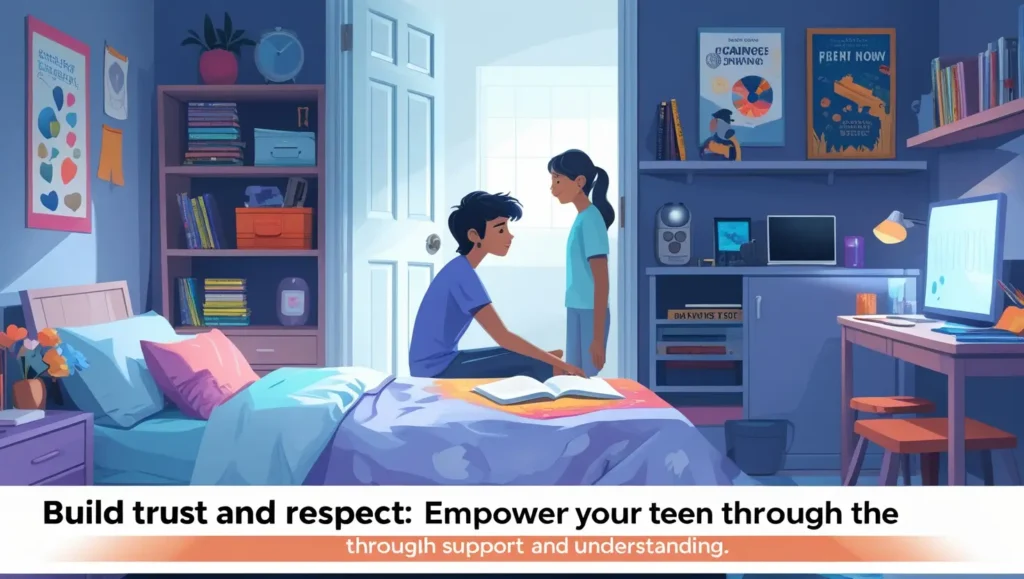
4. Build Trust and Respect
- Consistency, including when you fail. If you promise to be at the recital and work overruns, the repair matters more than the miss. A genuine apology without excuses teaches that accountability is normal rather than humiliating.
- Respect privacy. Personal space is how identity forms. Respecting it, within boundaries you’ve set together, communicates that you expect them to be trustworthy — which is itself part of how they become trustworthy.
- Be honest about your reasoning. “Because I said so” ends a conversation without changing a mind. Explaining the actual concern behind a rule gives them something to reason with.
The mechanics of trust apply well beyond parenting — our guide to building trust in relationships covers the same ground more generally, and the key differences between healthy and unhealthy relationships is worth reading if you want your teen to be able to recognise both.

5. Encourage Independence Within Boundaries
The CDC finding on parental monitoring is easy to misread as an argument for surveillance. It isn’t. Monitoring in that research means knowing where your teen is and who they’re with — which mostly depends on them being willing to tell you.
- Decide together where you can. Teens follow rules they helped write at a noticeably higher rate than rules imposed on them.
- Let them practise judgment on low-stakes decisions. Weighing up whether a sports commitment fits around schoolwork is a rehearsal for decisions that will matter more later.
- Hand over real responsibility. Budgeting for something, managing their own schedule. Competence built now is competence they leave home with.

6. Show Unconditional Support
This is the practical shape of the connectedness finding. It’s less about declarations and more about whether support is contingent on performance.
- Small, low-pressure signals. A note before an exam. A text that doesn’t ask for anything.
- Acknowledge effort, not only outcomes. Praising only results teaches that your approval tracks achievement, which is exactly the association you don’t want forming during a period this stressful.
- Return to conflicts once they’ve cooled. Coming back to a disagreement calmly a day later demonstrates that the relationship survives disagreement — which is the actual lesson.

7. Address Emotional Challenges
Distinguishing ordinary adolescent volatility from something that needs help is one of the harder parts of this.
- Mood swings are expected. Fluctuation tied to events, that lifts, is typical development.
- Persistence is the signal. Low mood, withdrawal, changes in sleep or appetite, or loss of interest in things they cared about — sustained over weeks rather than days — is the pattern that warrants professional input. Given that 28.5% of high school students report poor mental health, this is common rather than exceptional, and seeking help early is not an overreaction.
- Teach transferable coping skills. Techniques they can use without you present are the point. We’ve ranked quick stress-relief techniques by how much evidence actually supports each one, and written a teen-specific guide to managing everyday stress that you could reasonably just hand them.
If academic pressure is the main driver, this guide to stress management for students is written for them rather than for you.
This article is general information, not medical advice. If you’re concerned about your teen’s mental health, speak to your doctor or a qualified mental health professional. If you believe they may be at risk of harming themselves, seek help immediately.

8. Lead by Example
Teenagers are unusually good at detecting the gap between what a parent says and what they do.
- Model the regulation you’re asking for. How you handle your own frustration is the most sustained demonstration they’ll get.
- Show them what respect looks like in your other relationships. How you speak to your partner, your own parents, and people serving you sets a baseline they’ll carry.
- Take your own wellbeing seriously. Partly because it makes you a more patient parent, and partly because a teenager watching a parent run themselves into the ground learns that this is what adulthood requires.
Frequently Asked Questions
Connectedness — whether your teen experiences you as reliably there. The Add Health study of over 90,000 adolescents found parent-family connectedness protective against nearly every health risk outcome measured, including emotional distress and suicidal thoughts. It is not about a particular parenting style; it is about the relationship itself feeling secure.
Listen before solving. When your teen raises a problem, resist the immediate fix and try “That sounds stressful, how are you thinking of handling it?” Teens disclose more when they feel heard rather than managed. Side-by-side settings — car journeys, cooking, washing up — tend to produce more openness than face-to-face conversations, because either person can let a subject drop without it becoming a confrontation.
Yes, within boundaries you have set together. Wanting privacy is normal identity development, not evidence of something wrong. Note that “parental monitoring,” which CDC data associates with better outcomes, means knowing where your teen is and who they are with — which depends far more on them being willing to tell you than on surveillance.
The evidence is better than for most parenting advice. A systematic review found frequent family meals inversely associated with disordered eating, substance use, violent behaviour and depressive symptoms, and positively associated with self-esteem and school success. It is observational research, so it demonstrates association rather than proven cause — but it is a low-cost habit with consistent findings behind it.
Mood fluctuation tied to events, which lifts afterwards, is a normal part of adolescent development. What warrants closer attention is persistence — low mood, withdrawal, changes in sleep or appetite, or lost interest in things they used to care about, sustained over weeks. That pattern is a reason to involve a professional.
The data suggests the population you are parenting is under more strain. In the CDC’s 2023 Youth Risk Behavior Survey, 28.5% of US high school students reported experiencing poor mental health. That does not mean every family is in difficulty, but if this feels harder than you expected, the context is real rather than a failure of your parenting.
Conclusion
The most useful thing in all of the research above is also the most forgiving: what protects teenagers most is not a technique you have to execute correctly, but a relationship in which they feel connected to you. That is built through ordinary repetition — meals, car journeys, being reliably present, repairing things when you get them wrong.
You will get conversations wrong. That’s survivable, and demonstrating that a relationship recovers from friction is itself worth teaching. Consistency over years does more than any individual conversation, which is good news, because no one gets every conversation right.