

Ever jolted awake from a dream so real you could swear it happened? Or dragged through a day with your brain stuck in molasses after a night of tossing and turning?
Sleep isn’t downtime. It’s when your brain clears waste, files memories, and resets your emotional thermostat — and dreams are part of that process. But a lot of what you’ve been told those dreams mean doesn’t survive contact with the research. This guide separates the two: what sleep demonstrably does, what dreams demonstrably don’t, and which popular sleep fixes are actually backed by anything.
Key Takeaways
- The target isn’t 8 hours — it’s 7 or more. A 15-expert panel reviewing over 5,300 studies settled on that figure, and stressed that individual need genuinely varies (Watson et al., Journal of Clinical Sleep Medicine, 2015).
- “I’m fine on 4 hours” is the one claim to distrust — including when it comes from you. After 14 nights at 6 hours or less, people performed as badly as if they’d gone two full nights without sleep, while their own sleepiness ratings barely moved (Van Dongen et al., Sleep, 2003).
- The teeth-falling-out dream has actually been tested empirically — and it tracks tension in your jaw on waking, not fear of aging or loss of control (Frontiers in Psychology, 2018).
- This isn’t a niche problem: 30.5% of US adults sleep under seven hours, and only 54.8% usually wake up well-rested (CDC/NCHS, 2024 National Health Interview Survey).
- The sleep aids further down are graded by how strong the evidence actually is — and two of the most-recommended ones rate weaker than their reputation.
What Is Sleep?
Sleep isn’t your body hitting “pause.” Think of it as the night shift clocking in. While you’re out, your brain is clearing metabolic waste, your tissues are repairing, and your memories are being sorted and filed. Scrolling until 2 AM does not count as prepping for any of it.
Here’s roughly what happens once you’re under:
- Light Sleep: The warm-up act — heartbeat slows, muscles relax, and your brain starts muting the day’s noise.
- Deep Sleep: The physically restorative phase, when tissue repair and growth-hormone release are concentrated.
- REM Sleep: Where most vivid dreaming happens, and where emotional and memory processing is heaviest. Miss it and you wake up feeling emotionally scrambled — which, as you’ll see below, is measurable rather than metaphorical.
Pull an all-nighter and your brain will claw back the REM it lost the following night. The Sleep Foundation calls this “REM rebound” — a decent sign your body treats this phase as non-optional.
How Much Sleep Do You Actually Need?
Almost every article on this subject opens with “get your 8 hours.” That number is folklore dressed up as a guideline, and it’s worth correcting before anything else.
In 2015, the American Academy of Sleep Medicine and the Sleep Research Society convened a panel of 15 experts who reviewed more than 5,300 scientific articles and issued a joint consensus statement: adults aged 18 to 60 should sleep 7 or more hours per night. Not eight. Seven is the floor below which the health risks — weight gain, hypertension, depression, heart disease — start stacking up.
The panel was equally clear on the other half: how much you personally need above that floor is shaped by genetics, age, health and what you’re currently demanding of your body. So the useful question isn’t “did I hit eight?” It’s whether you can get through an ordinary afternoon without caffeine propping you up.
Why Sleep Matters
You’ve almost certainly met someone who insists they run fine on four or five hours. Here’s the uncomfortable part: they may genuinely believe it, and be wrong anyway.
Van Dongen and colleagues (Sleep, 2003) put 48 healthy adults in a lab and restricted them to 4, 6, or 8 hours in bed for 14 consecutive nights. The people at 6 hours or less accumulated cognitive deficits equivalent to going up to two full nights without any sleep at all. The finding that matters most, though, is what those people reported: their subjective sleepiness ratings spiked once at the start and then flattened out, and didn’t meaningfully separate the 6-hour group from the 4-hour group. The authors put it plainly — subjects were largely unaware their performance was still degrading.
That’s the real version of the “I only need four hours” story. It isn’t that some people are immune. It’s that the instrument you’d use to notice the damage — your own sense of how tired you are — stops tracking it.
Two other effects are worth naming, because they’re the ones people misread as personal failings:
- Your appetite signals get rewired. In a controlled study of 12 healthy young men (Spiegel et al., Annals of Internal Medicine, 2004), two nights of restricted sleep dropped leptin (the fullness hormone) 18%, raised ghrelin (the hunger hormone) 28%, and increased self-reported hunger 24% — with the sharpest cravings for calorie- and carbohydrate-dense food. Small study, men only, short duration — but it’s a plausible mechanism for why a bad week of sleep feels like a collapse of willpower.
- Your emotional brakes come off. Yoo and colleagues (Current Biology, 2007) scanned people after a night with no sleep and found the amygdala — the brain’s threat alarm — firing roughly 60% harder at distressing images than in the rested group, while the prefrontal cortex that normally talks that alarm down had largely stopped communicating with it. That’s the 3 a.m. spiral, visible on a scan.
If that last one sounds familiar, the overlap between poor sleep and daytime stress runs both ways, and it’s worth attacking from the other end too — we’ve collected the approaches that hold up in stress-reduction techniques that actually work, and specifically for students under exam-season pressure in our guide to stress management for students.
What Your Brain Is Actually Doing While You’re Out
Most sleep advice stops at “get eight hours” and calls it a day. So let’s go further — what is your brain actually doing between lights-out and your alarm, and which parts of that are settled science versus stuff the internet just repeats?
Two findings do most of the heavy lifting:
- Your brain runs a night-shift cleaning crew. In a 2013 study in Science, Xie and colleagues found that when mice fall asleep, the space between their brain cells widens by roughly 60% — letting fluid wash through and flush out waste, including the beta-amyloid protein that clumps together in Alzheimer’s disease. Worth flagging honestly: that was mice, not people. It’s the most convincing mechanical explanation we have for next-day brain fog, not a settled fact about your skull.
- Sleep doesn’t just store memories — it reshuffles them. Wagner and colleagues (Nature, 2004) trained volunteers on a number task that had a hidden shortcut nobody was told about. After eight hours of sleep, more than twice as many people spotted the shortcut as those who stayed awake — and it made no difference whether they slept at night or during the day. The catch comes straight from the study: sleep did nothing for people who hadn’t done the training first. Sleeping on a problem works. Sleeping instead of working on it does not.
Put those alongside the emotional findings above and sleep debt stops looking like ordinary tiredness and starts looking like a temporary personality change. And it’s widespread: in CDC figures from the 2024 National Health Interview Survey, 30.5% of US adults were sleeping under seven hours a night, and only 54.8% said they usually wake up well-rested.
The Mystery of Dreams
Dreams are your brain’s late-night improv show — unpredictable, chaotic, occasionally deeply strange. Why do we dream about sitting an exam we never studied for, or sprouting wings over a city made of cheese?
The leading explanations treat dreaming as part of how the brain processes emotion and consolidates memory rather than as random neural noise. What comes next is where the confidence usually outruns the evidence: every culture has interpreted dreams differently. Ancient Egyptians read them as divine messages. Freud read them as repressed desire. Modern researchers are still arguing — and, as you’re about to see, when someone finally ran the numbers on one of the most famous dream symbols, the traditional reading lost.
Common Dream Themes
Some dreams really are close to universal, and that part isn’t folklore. When Nielsen and Zadra (Dreaming, 2003) surveyed 1,181 first-year university students across three Canadian cities, the prevalence rates were striking:
- Being chased or pursued — reported by 81.5%, the single most common theme.
- Falling — 73.8%.
- Teeth falling out — 18.8%. Far less common than its cultural fame suggests, but still roughly one person in five.
The themes held remarkably steady across age, gender and region. So the observation is real. It’s the translations bolted onto them — falling means anxiety, being chased means avoidance, teeth mean fear of aging — that have never had much behind them.
What the Teeth Dream Actually Turned Out to Be
This is the one case where someone bothered to test the symbolism directly, and the result is a useful corrective to almost every dream-meaning article online, including older versions of this one.
Researchers publishing in Frontiers in Psychology (2018) surveyed 210 students, measuring both psychological distress and physical dental sensations. If the symbolic reading were right, teeth dreams should track distress. They didn’t — the correlation was effectively zero. What teeth dreams did track was tension in the teeth, gums or jaw on waking. The authors concluded that their findings support the dental-irritation explanation and do not support the symbolic one.
In other words: the most-interpreted dream symbol of all is, on the current evidence, most likely your jaw talking. Not your midlife crisis.
Dreams aren’t the only night-time experience people load with meaning. For another case where the popular spiritual reading gets tested against the research, see what déjà vu means spiritually.
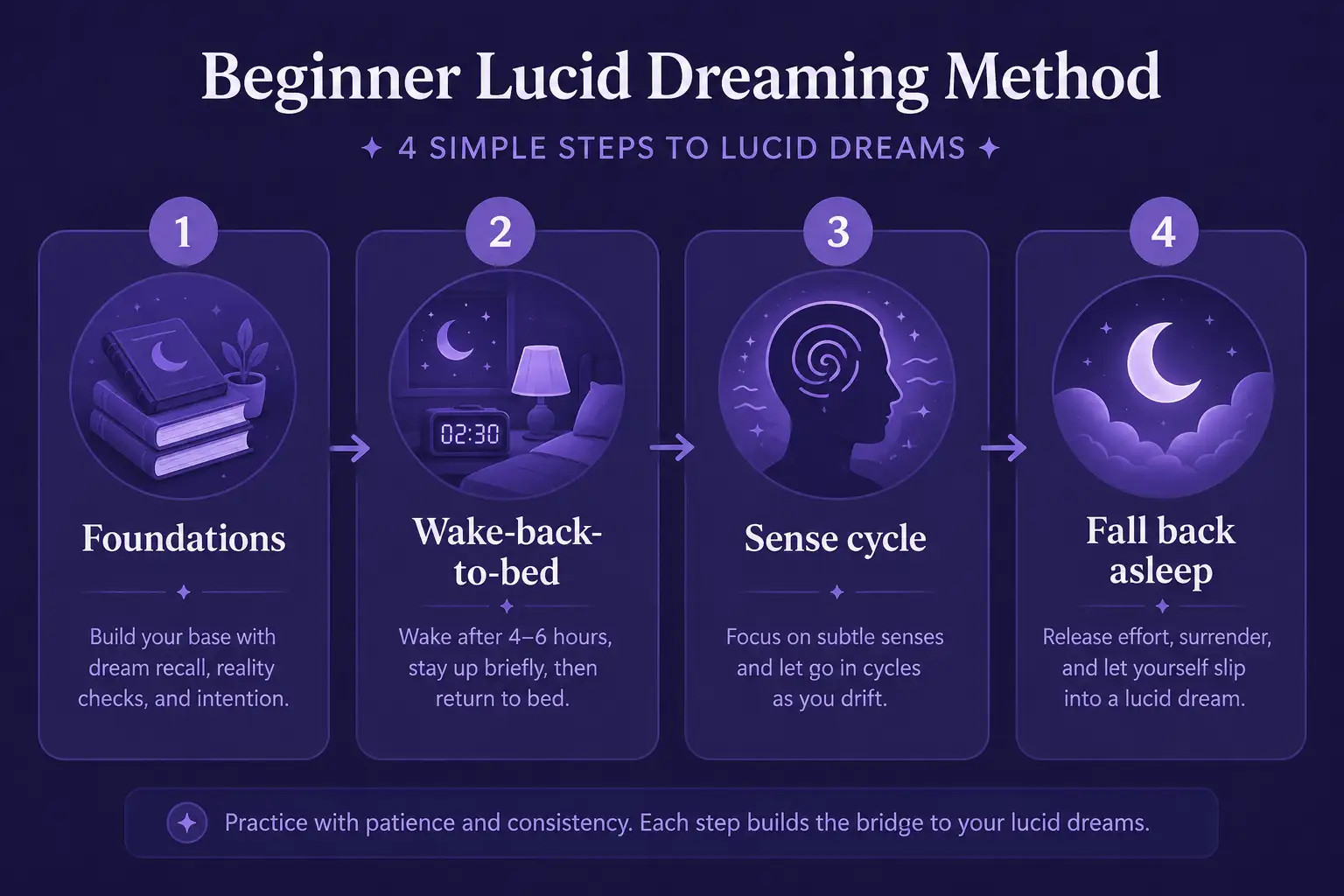
One important limit — that’s a single study on a student sample, and it tested one theme, not all of them. It doesn’t prove every dream symbol is physiological. What it does show is what happens the one time a popular interpretation was actually put to the test. If you want to go further into the one category of dreaming where you can genuinely steer the content, we cover that in lucid dream meaning: what it really tells you about your mind.
Where the Science Stops and the Guesswork Starts
Here’s the dividing line, because a lot of sleep content blurs it. What sleep does — consolidate memory, regulate emotion, clear waste — is measurable, repeatedly tested lab work. What any single dream means is not.
The tidy translations for falling and being chased come from cultural and psychoanalytic tradition, not from research that tested whether those readings hold up. No lab has produced a fixed symbol-to-meaning dictionary that works across different people.
So use them the way they’re genuinely useful: as a prompt for reflection, not a diagnosis. If a recurring dream keeps circling the same theme, the interesting question isn’t “what does the internet say teeth mean?” — it’s “what in my life right now feels like it’s coming loose?”
Practical Tips for a Restful Night and Vivid Dreams
Most sleep-tip lists present every suggestion as equally effective. They aren’t. Here they are sorted by how much evidence is actually behind them — strongest first, weakest last, with the weak ones kept in and labelled rather than quietly dropped.
Well supported: get the screens out of the last hour
This is the one with the cleanest mechanism. Chang and colleagues (PNAS, 2015) had participants read either a light-emitting e-reader or a printed book before bed. The e-reader nights suppressed evening melatonin by around 55%, pushed the body’s melatonin onset more than an hour and a half later, delayed REM sleep, and left people measurably less alert the next morning. Only 12 people took part, so treat the exact percentages loosely — but the direction of the effect has held up across later work. Paper book, not tablet, is a genuinely evidence-based swap.
Well supported: keep the schedule boring
The single most reliable thing you can do is go to bed and get up at roughly the same times, including weekends. It sounds like the dullest advice on the list, and it’s the one with the least argument against it — regularity is what the circadian system actually responds to. If a wind-down routine helps you protect that slot, a short meditation practice is a reasonable anchor, and we walk through one viral variant of the idea in this sleep hack went viral — but does it really work?
Mixed evidence, oversold: lavender
You’ll see lavender recommended as settled science. It isn’t. Meta-analyses do find a real signal — one 2025 review pooling 11 randomised trials and 628 adults reported a moderate improvement in sleep quality — but reviewers grade the certainty of that evidence as very low, citing serious risk of bias, inconsistent results and probable publication bias. There’s also an unavoidable structural problem: you cannot blind a participant to a smell. If it relaxes you, use it. Just don’t file it next to the melatonin research.
Weak evidence, popular anyway: valerian root
The most-cited review here is Bent and colleagues (The American Journal of Medicine, 2006), which pooled 16 studies covering 1,093 patients. Their verdict was that valerian might improve sleep quality without notable side effects, but that most of the studies had significant methodological problems and the evidence was not sufficient to draw firm conclusions. Nearly two decades on, that’s still roughly where it sits. Low risk, low confidence.
Untested, but harmless: grounding exercises and the pre-sleep wind-down
The 5-4-3-2-1 technique — name five things you see, four you feel, three you hear, two you smell, one you taste — has no dedicated sleep-onset trial behind it that we could find. Same for “make whatever you watch boring.” They cost nothing and they displace doomscrolling, which is the actual benefit. That’s a fair reason to try them; it isn’t evidence that they work.
Keep a dream journal (this one is about recall, not health)
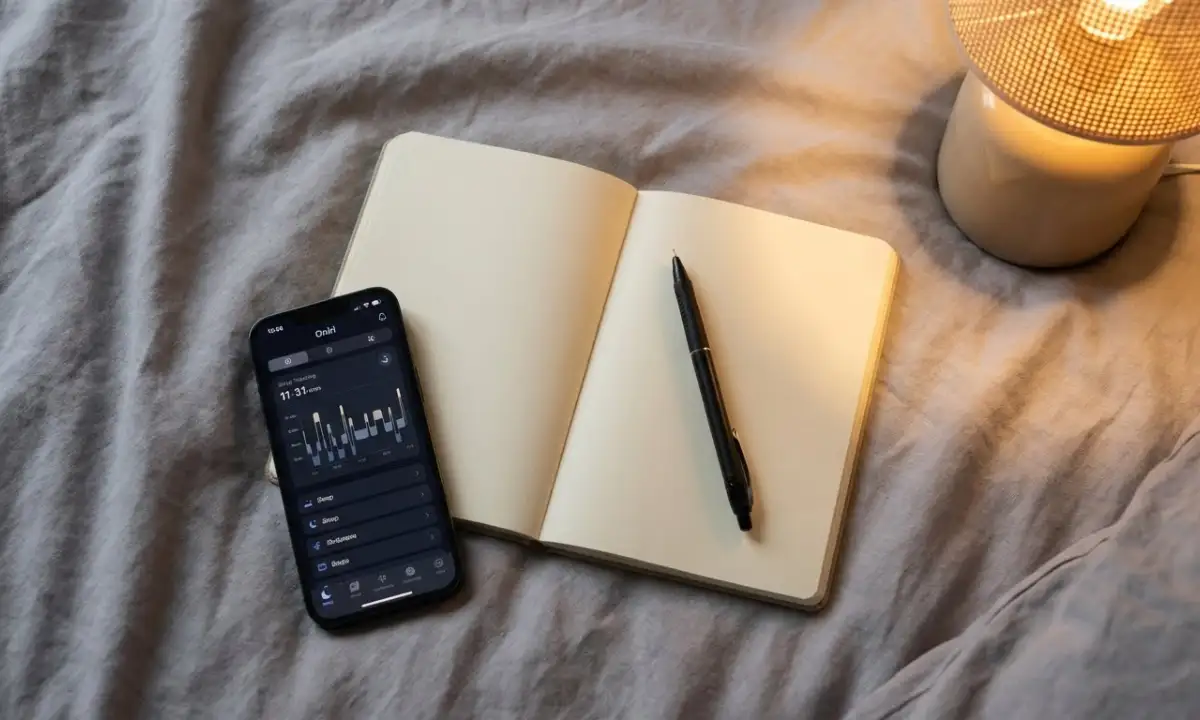
Dream memories decay within minutes of waking. For the full method, see how to remember your dreams. If you want to notice patterns across weeks — whether stress dreams cluster around deadlines, say — a notebook or voice memo within the first minute or two of waking is the only reliable way to catch them. Just be honest about what you’re doing: collecting data on your own mind, not decoding messages.
When It’s Not a Habit Problem
Everything above assumes your sleep is fixable with behaviour. Sometimes it isn’t, and the tips become a way of blaming yourself for a medical problem.
Worth raising with a doctor rather than a blog: loud snoring with pauses in breathing, or a partner reporting them; waking repeatedly gasping or choking; sleeping a full night and still being unable to stay awake during the day; persistent difficulty falling or staying asleep for more than a few weeks; or nightmares frequent enough to disrupt your life. Untreated sleep apnea in particular is common, underdiagnosed, and does not respond to lavender — we go into how it interacts with dreaming and REM sleep in dreaming and sleep apnea: understanding the connection.
This article is for general information and isn’t medical advice. If your sleep is persistently disrupted or you recognise any of the symptoms above, speak to a qualified healthcare provider.
Frequently Asked Questions
The 8-hour figure is convention rather than a research finding. The 2015 joint consensus statement from the American Academy of Sleep Medicine and the Sleep Research Society, drawn from a review of over 5,300 studies, recommends 7 or more hours per night for adults aged 18 to 60. Individual need above that floor genuinely varies with genetics, age and health. The clearer signal than any hour count is how you function the next day.
Dream recall fades fast because the brain chemistry involved in memory consolidation during REM sleep differs from the waking state. Keeping a notebook or voice recorder at your bedside and capturing anything you remember within the first minute or two of waking is the most reliable way to catch dreams before they evaporate.
Late, heavy or spicy meals can fragment sleep and increase the odds of vivid or unsettling dreams, likely because disrupted sleep means more time in lighter stages where dream recall is higher. The link isn’t firmly established, but if odd dreams are bothering you, a lighter and earlier dinner is a reasonable first thing to try.
On the only direct empirical test of the question, it most likely means your jaw is tense. A 2018 study in Frontiers in Psychology surveyed 210 people and found teeth dreams correlated with tension sensations in the teeth, gums or jaw on waking, and showed essentially no correlation with psychological distress. The authors concluded the findings support a dental-irritation explanation rather than the traditional symbolic reading about fear of aging or loss of control.
Almost certainly not as often as people claim. In a 2003 lab study published in Sleep, adults restricted to 6 hours or less for 14 nights accumulated cognitive deficits comparable to going up to two full nights without sleep — but their own sleepiness ratings plateaued early and failed to distinguish the 6-hour group from the 4-hour group. The researchers noted subjects were largely unaware their performance was still declining. Self-assessment is the least reliable measure available.
Both have some supporting evidence, and both are weaker than their reputation. Meta-analyses of lavender find a moderate effect on sleep quality but grade the certainty of that evidence as very low, and a scent cannot be properly blinded in a trial. For valerian, a 2006 review in The American Journal of Medicine covering 16 studies and 1,093 patients concluded it might help without notable side effects, but that methodological problems meant firm conclusions weren’t possible. Both are low-risk to try and low-confidence to rely on.
Consider it if you snore loudly with pauses in breathing, wake gasping or choking, remain unable to stay awake during the day despite a full night in bed, have persistent trouble falling or staying asleep for more than a few weeks, or have nightmares frequent enough to disrupt daily life. These point toward conditions such as sleep apnea or insomnia disorder, which need assessment rather than better bedtime habits.
Wrapping Up – Better Sleep, Fewer Myths
If you take three things from this: the number to aim for is seven or more hours, not eight. Your own sense of how tired you are is the least trustworthy instrument you own once you’re running a deficit. And the confident meanings attached to dream symbols are, at best, a prompt for reflection — the one time a famous symbol was properly tested, it turned out to be about jaw tension.
Everything above is a starting point, not a prescription. Sleep is stubbornly individual — the wind-down that knocks one person out cold does nothing for the next. If you’ve landed on something that genuinely works for you, or you’ve got a recurring dream strange enough to deserve a second opinion, the comments are open.






1 thought on “Sleep and Dreaming: What Your Brain Actually Does at Night”